Frailty alters link between blood-flow procedures and amputation
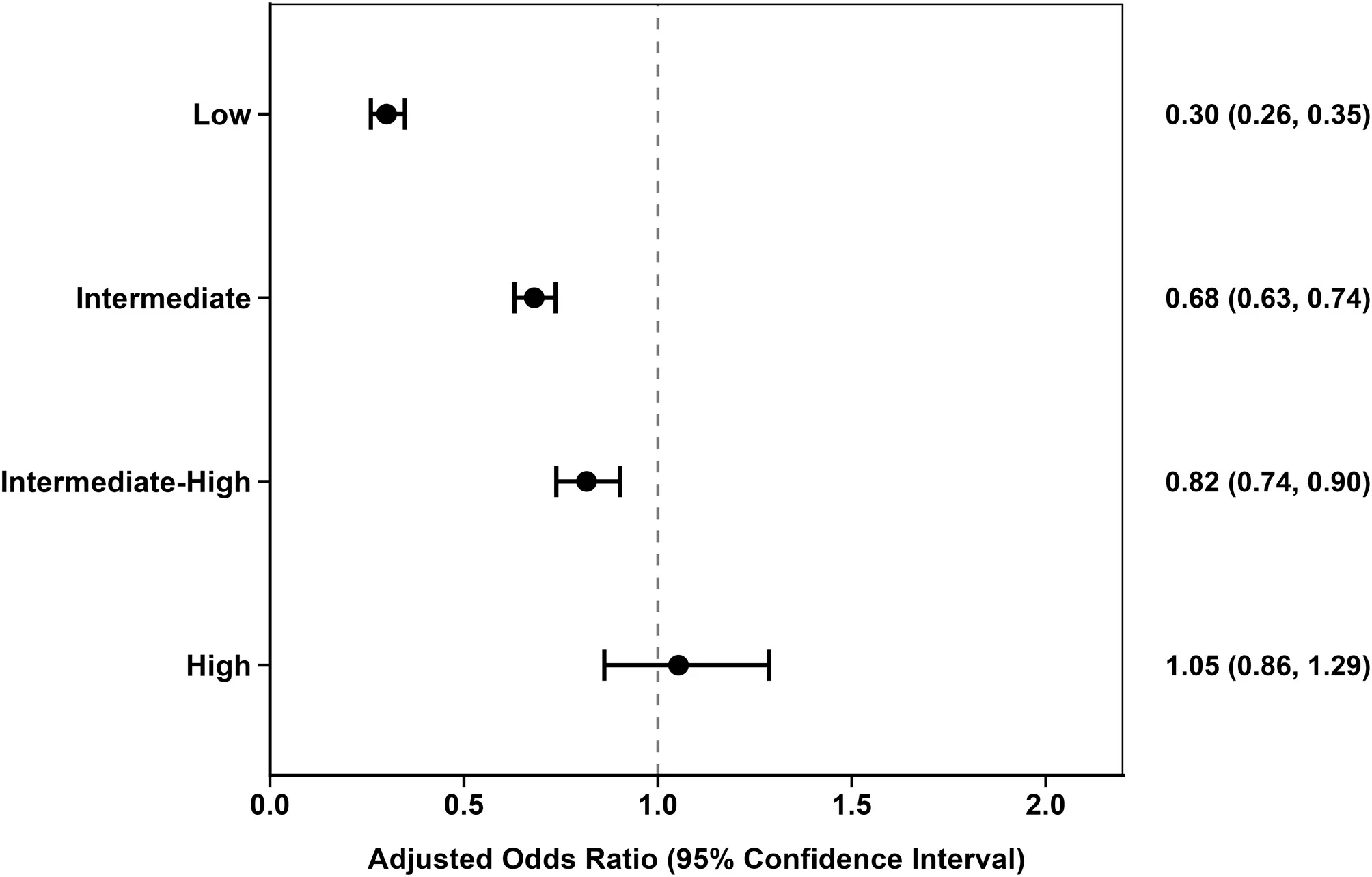
The adjusted odds ratio for major amputation with versus without blood-flow procedures was 0.30 with low frailty and 1.05 with high frailty.
Our read
Populations- Studied:
- Cohort study of 2,588,159 weighted admissions for diabetic foot ulcers, during hospitalization (Independent replication)
- What changed:
- Amputation odds with versus without revascularization were lower at low frailty (OR 0.30), but not clearly different at highest frailty (1.05)
- The catch:
- Ischemic severity and procedural suitability affect treatment selection but were inadequately captured
- In the record:
- The 16th paper on revascularization with results in people; 34 on record in all.
Editor of record: Boris Djordjevic · AgingResearch.News
US hospitalizations for diabetic foot ulcers among adults aged 18 or older were analyzed in a retrospective cohort study covering 2016 through 2022. The weighted total was 2,588,159 admissions; people could contribute more than one admission. Researchers grouped admissions by frailty, reduced resilience to illness, using diagnosis codes. They compared admissions with and without revascularization, procedures to restore blood flow to the legs.
The association with lower odds of major amputation weakened as frailty increased. Odds ratios compare odds between groups; values below 1 indicate lower odds. In the highest-frailty group, the range of likely values included no difference. Revascularization was also associated with lower in-hospital mortality across frailty groups.
Why it matters
Frailty raises a question for care in later life: how vulnerability to illness should factor into decisions about procedures intended to preserve a limb.
Caveats
The authors note that people selected for revascularization may have differed in wound severity, suitability for procedures and treatment preferences, which could also affect amputation risk. The findings concern hospitalized adults, not people managed outside the hospital.
Where the evidence stands
Revascularization
- 16 independent labs in 6 countries
- 3 findings against
- Funders: National Institutes of Health and others
- 1 of 21 findings with company ties
From the paper
- Result
Mean HFRS was 8.21 (95% CI 8.19–8.23) among DFU hospitalizations compared with 6.33 (95% CI 6.31–6.34) among non-DFU diabetes hospitalizations, corresponding to a mean difference of 1.89 points (95% CI 1.87–1.90; p < 0.001).
- Limitation
First, the observational design precludes causal inference regarding the effects of revascularization on major amputation or in-hospital mortality.
Quoted word for word from the full text on onlinelibrary.wiley.com.
The paper
Perelman School of Medicine University of Pennsylvania Philadelphia Pennsylvania USA; and Informatics University of Pennsylvania Perelman School of Medicine Philadelphia Pennsylvania USA
International Wound Journal, Nov 11, 2026, Open access, CC BY-NC




Comments
Be the first to comment.