Protein loss weakened barriers in human brain vessel cells
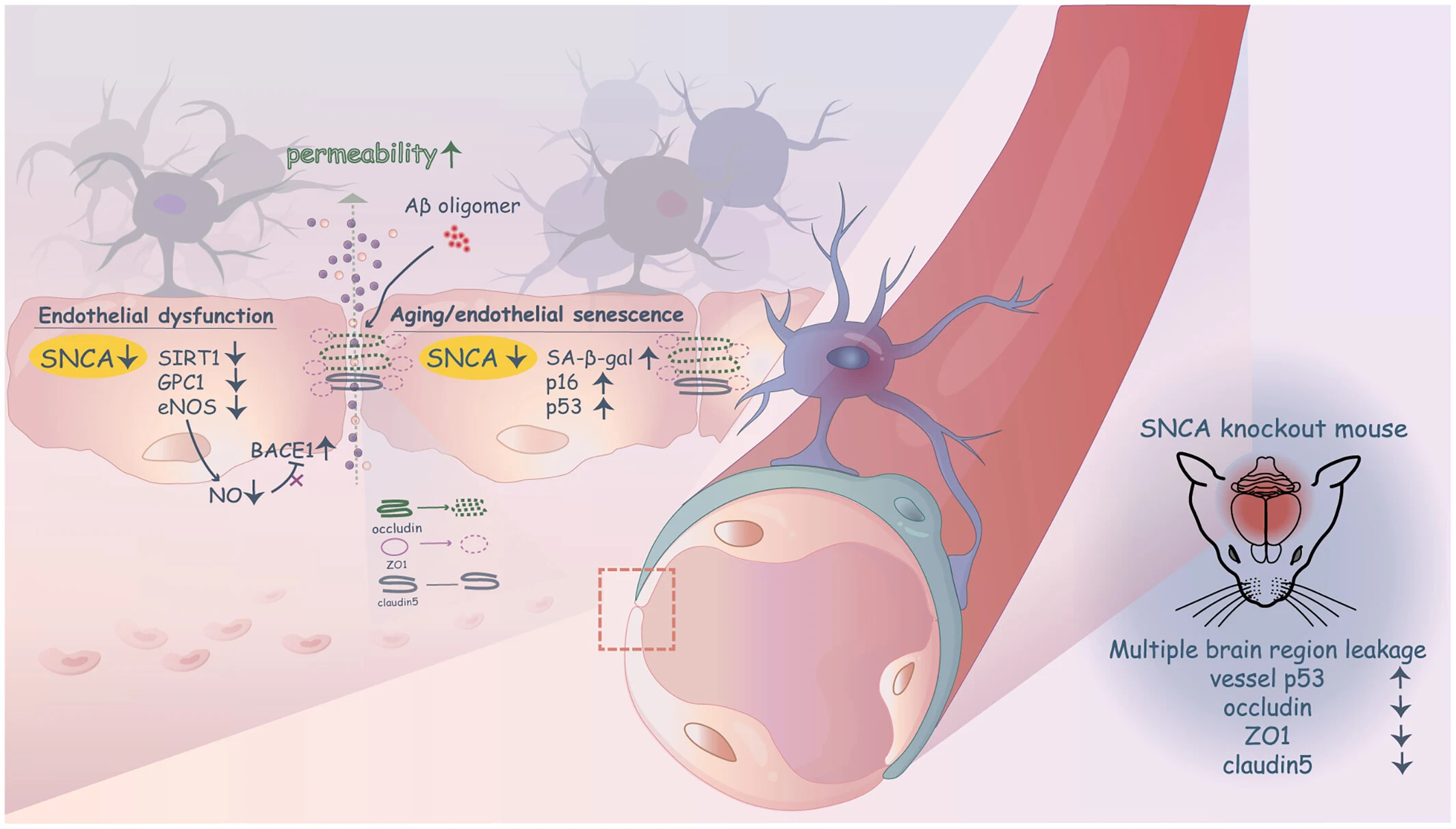
In lab experiments, reducing alpha-synuclein, a protein, made layers of human brain blood-vessel cells leakier; suppressing an enzyme returned leakage to normal.
Our read
Mechanisms- Studied:
- Experiments in cells
Editor of record: Boris Djordjevic · AgingResearch.News
Human brain microvascular endothelial cells, which line the brain’s smallest blood vessels, were grown in the lab for experiments on barrier function. Repeated rounds of cell division induced senescence, a state in which cells stop dividing, and reduced alpha-synuclein, a protein.
Silencing the gene for alpha-synuclein produced a senescence-like state, reduced proteins that form tight junctions—the seals between neighboring cells—and increased leakage through cell layers. It also increased levels and activity of BACE1, an enzyme. Suppressing BACE1 at the same time restored junction proteins and returned leakage to normal. Male mice lacking alpha-synuclein throughout the body also showed blood–brain barrier leakage, already present at nine weeks of age. Aged mice without the gene deletion showed similar barrier defects and reduced alpha-synuclein in brain microvessels.
Why it matters
Blood–brain barrier dysfunction is an early feature of brain aging. The authors identify declining alpha-synuclein in vessel-lining cells as a candidate contributor to age-related barrier vulnerability.
Caveats
Layers of cells grown in the lab do not reproduce the full blood–brain barrier. The gene-deletion experiments used male mice lacking the protein throughout the body, rather than only in vessel-lining cells.
From the paper
- Limitation
siRNA-induced off-target effects and transfection stress cannot be fully excluded, though BACE1 co-silencing rescue supports biological relevance; a gain-of-function SNCA rescue was not performed given its aggregation-prone toxicity.
Quoted word for word from the full text on onlinelibrary.wiley.com.
The paper
Department of Geriatric and General Medicine The University of Osaka Graduate School of Medicine Osaka Japan
Aging Cell, Nov 9, 2026, Open access, CC BY
Comments
Be the first to comment.