A memory-linked brain pathway strengthened with age in mice
Experiments found changes that differed by sex, while reducing the pathway’s activity improved memory in aged mice.
Our read
Mechanisms- Studied:
- Experiments in mice
- What changed:
- Signals from the hippocampus strengthened as mice aged
- The catch:
- The magnitude of the age-related increase in pathway strength is not reported
Editor of record: Boris Djordjevic · AgingResearch.News
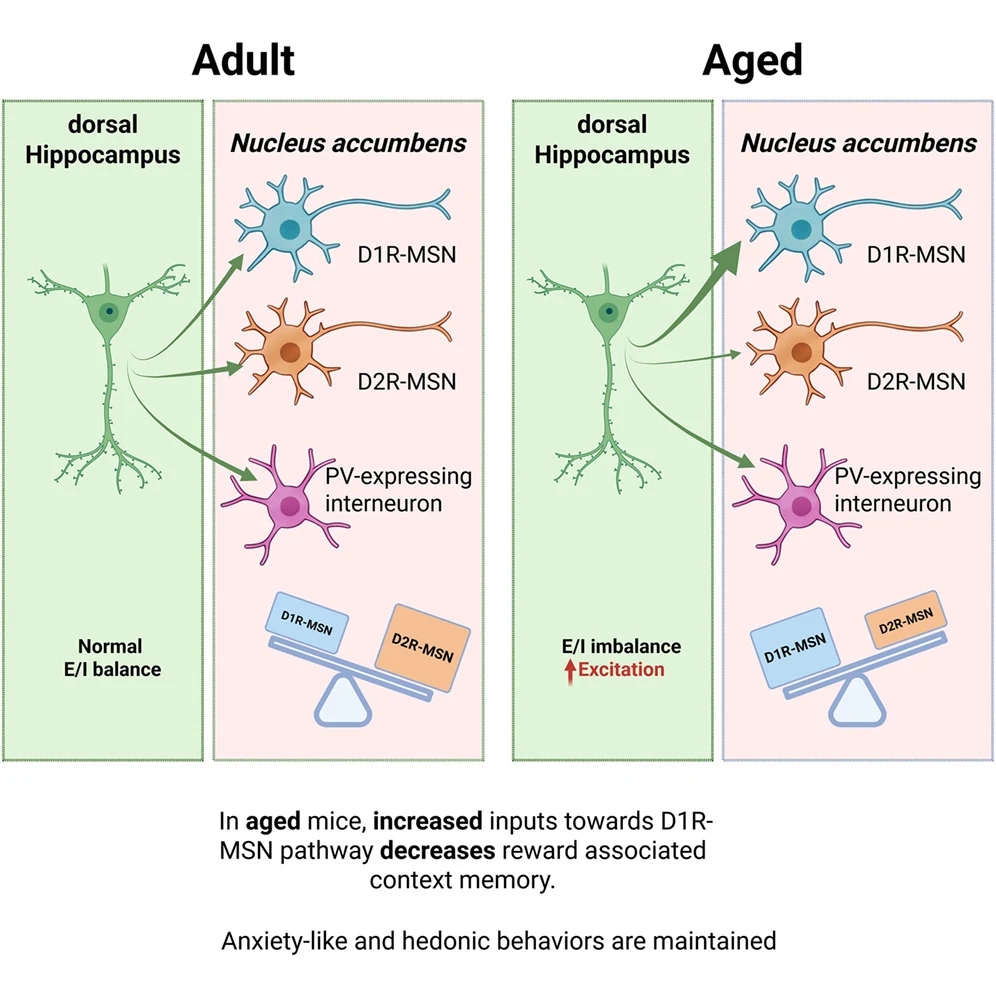
Mice showed age-related changes that differed by sex in experiments on a pathway linking two brain regions. The pathway connected the hippocampus, which supports memory, to the nucleus accumbens, which helps guide goal-directed behavior. The team combined light- and chemical-based control of nerve cells with electrical recordings and behavior tests.
As mice aged, the balance between activating and restraining signals shifted toward excessive nerve-cell activity in part of the hippocampus. Signals leaving this region strengthened, selectively increasing input to one type of nerve cell in the nucleus accumbens. The changes also involved a newly identified long-distance nerve-cell connection. Using chemical-based control to reduce the pathway’s activity improved memory in aged mice.
Why it matters
Spatial navigation and memory are among the abilities affected early in aging. The authors propose targeting this circuit during a window when intervention may change the course of cognitive decline.
Caveats
The memory benefit came from experiments in aged mice; whether reducing this pathway’s activity would improve memory in people remains open.
- Chemogenetic reduction of dorsal hippocampus–nucleus accumbens activity
- Synaptic transmission
- Cognitive impairment
- Posterior hippocampal activity
- Posterior hippocampus–nucleus accumbens coupling
- Mice
The paper
Reinforced hippocampus-accumbens pathway marks a shift toward cognitive decline in aging
Centre National de la Recherche Scientifique
Cell Reports, Nov 19, 2026, Open access, CC BY-NC


Comments
Be the first to comment.