Poor sleep linked to higher estimated ages across organs
Compared with healthy sleep patterns, poor patterns were linked to 1.463 times the odds of accelerated aging in at least two organ systems.
Our read
Populations- Studied:
- Cross-sectional study of 247,697 UK Biobank participants without major chronic disease
- What changed:
- Poor sleepers had higher odds of unusually high organ age estimates across multiple organs than healthy sleepers (OR 1.463)
- The catch:
- Sleep apnea was omitted from the analysis and could influence organ aging
- In the record:
- The 9th paper on sleep patterns with results in people; 13 on record in all.
Editor of record: Boris Djordjevic · AgingResearch.News
The 247,697 UK Biobank participants, who had no major chronic disease and averaged 55.20 years old, took part in a community-based observational study of sleep and estimated organ ages. They reported sleep duration, preferred sleep timing, insomnia, snoring and daytime sleepiness. Researchers classified their sleep patterns as healthy, intermediate or poor.
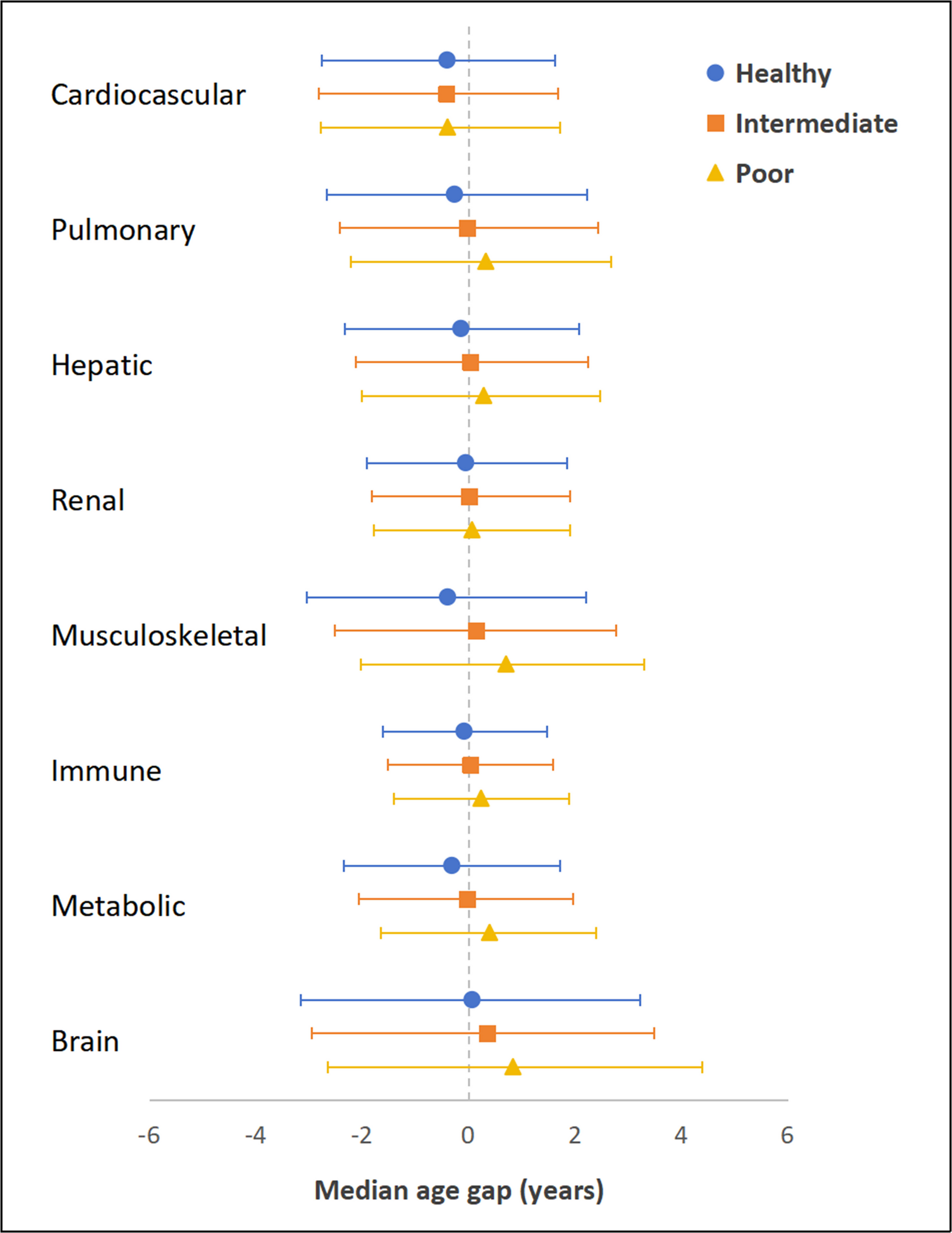
A computer-based analysis estimated ages for eight organ systems using health measurements and brain imaging. Researchers calculated the gap between each estimate and a participant’s actual age. They defined accelerated aging as a gap above the 95th percentile. Poor sleep patterns were associated with higher age gaps in seven systems, but not the cardiovascular system. They were also linked to accelerated aging in systems involving the lungs, liver, muscles and bones, immune defenses, metabolism and brain.
Why it matters
The authors suggest that sleep health may be a modifiable target for efforts to delay biological aging.
Caveats
The organ ages were computer estimates, and underlying health differences could have contributed to both poor sleep and higher age estimates. The findings may not apply to people with major chronic disease.
Where the evidence stands
Sleep patterns
- 10 independent labs in 1 country
- Funders: National Natural Science Foundation of China and others
Sleep duration
- 255 independent labs in 38 countries
- 89 findings against
- Funders: National Natural Science Foundation of China and others
- 32 of 575 findings with company ties
From the paper
- Participants
After excluding 201,232 participants with prevalent chronic diseases at baseline and 53,380 participants with missing data on sleep characteristics, a total of 247,697 chronic disease-free participants were included in the current analysis (Supplementary Fig. 1).
- Result
Having a poor compared to healthy sleep pattern was associated with significantly larger pulmonary age gap (β 0.621, 95%CI: 0.492, 0.749), hepatic age gap (β 0.321, 95%CI: 0.224, 0.418), renal age gap (β 0.097, 95%CI: 0.020, 0.175), musculoskeletal age gap (β 0.845, 95%CI: 0.712, 0.979) …
Quoted word for word from the full text on link.springer.com.
The paper
Association of sleep patterns with organ aging: a large community-based study
Tianjin Medical University General Hospital
GeroScience, Nov 24, 2026, Open access, CC BY-NC-ND

Comments
Be the first to comment.