Education, stable memory not linked to slower Alzheimer’s marker rise
In an observational study of 1,005 Swedish adults over 50, higher education and stable memory were not associated with slower marker increases over 10 years.
Our read
Populations- Studied:
- Cohort study of 526 adults from the population-based Betula study, 10 years (Independent replication)
- What changed:
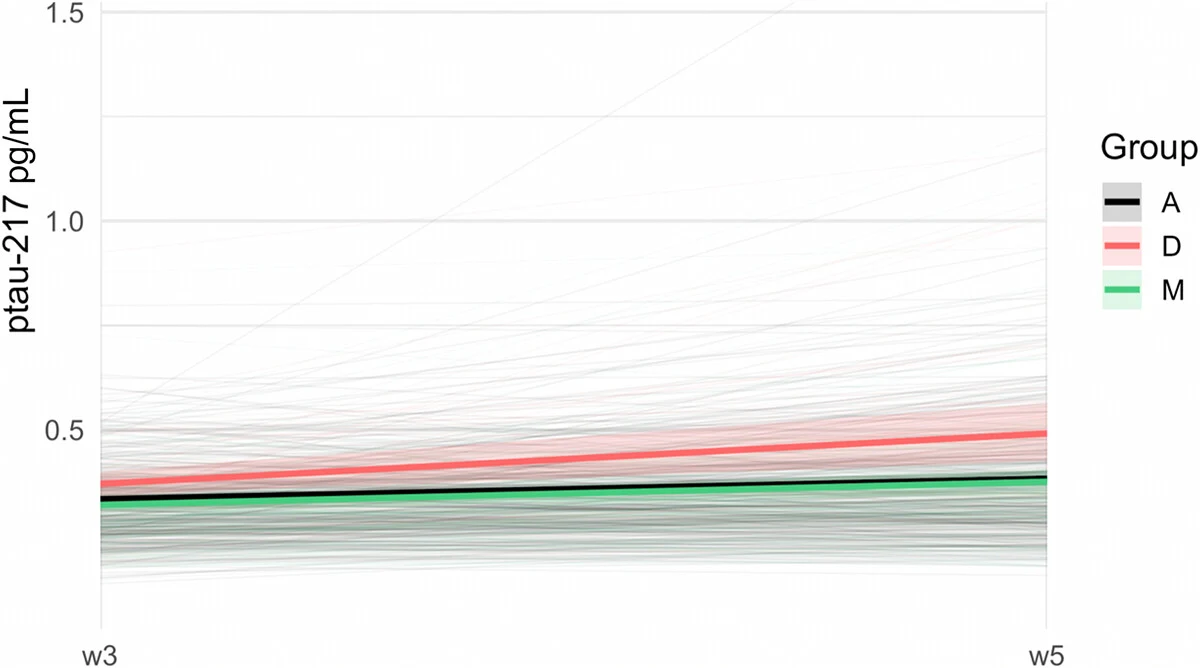
- Plasma p-tau217 rose at similar rates in people with stable memory and those with age-typical memory decline
- The catch:
- Kidney function and anemia, which influence plasma p-tau217, were not accounted for
- In the record:
- The 660th paper on education with results in people; 1,395 on record in all.
- Why it’s aging research:
- It looks at how biology varies with age or lifespan.
Editor of record: Boris Djordjevic · AgingResearch.News
In Umeå, Sweden, 1,005 women and men over 50 took part in an observational analysis within the Betula study. Researchers measured phosphorylated tau 217, a blood marker of early Alzheimer’s-related changes. Of these participants, 526 provided another blood sample 10 years later. Researchers grouped participants by memory-test patterns and education relative to others in their age group.
The marker rose over 10 years, most steeply among people with accelerated decline in memory for events and experiences. Its rate of increase did not differ detectably between people with stable memory and typical age-related memory decline, or between higher and lower education groups. A separate analysis of 388 adults over 50 without cognitive impairment in BioFINDER-2 also found no association with education.
Why it matters
Memory that stays stable in later life raises the question of whether it signals less underlying Alzheimer’s disease. The study addressed that distinction using a blood marker.
Caveats
A blood marker served as a proxy for Alzheimer’s-related changes, and only 526 of 1,005 Betula participants had repeat samples. Betula excluded people with dementia at enrollment and major neurological or psychiatric disorders.
From the paper
- Participants
The present study included 1005 participants from the longitudinal Betula cohorts S1 and S3 with available plasma samples at W3.
Quoted word for word from the full text on alz-journals.onlinelibrary.wiley.com.
The paper
Stockholm University; Umeå University
Alzheimer's & Dementia, Nov 4, 2026, Open access, CC BY


Comments
Be the first to comment.