Chronic conditions clustered more tightly in older patients
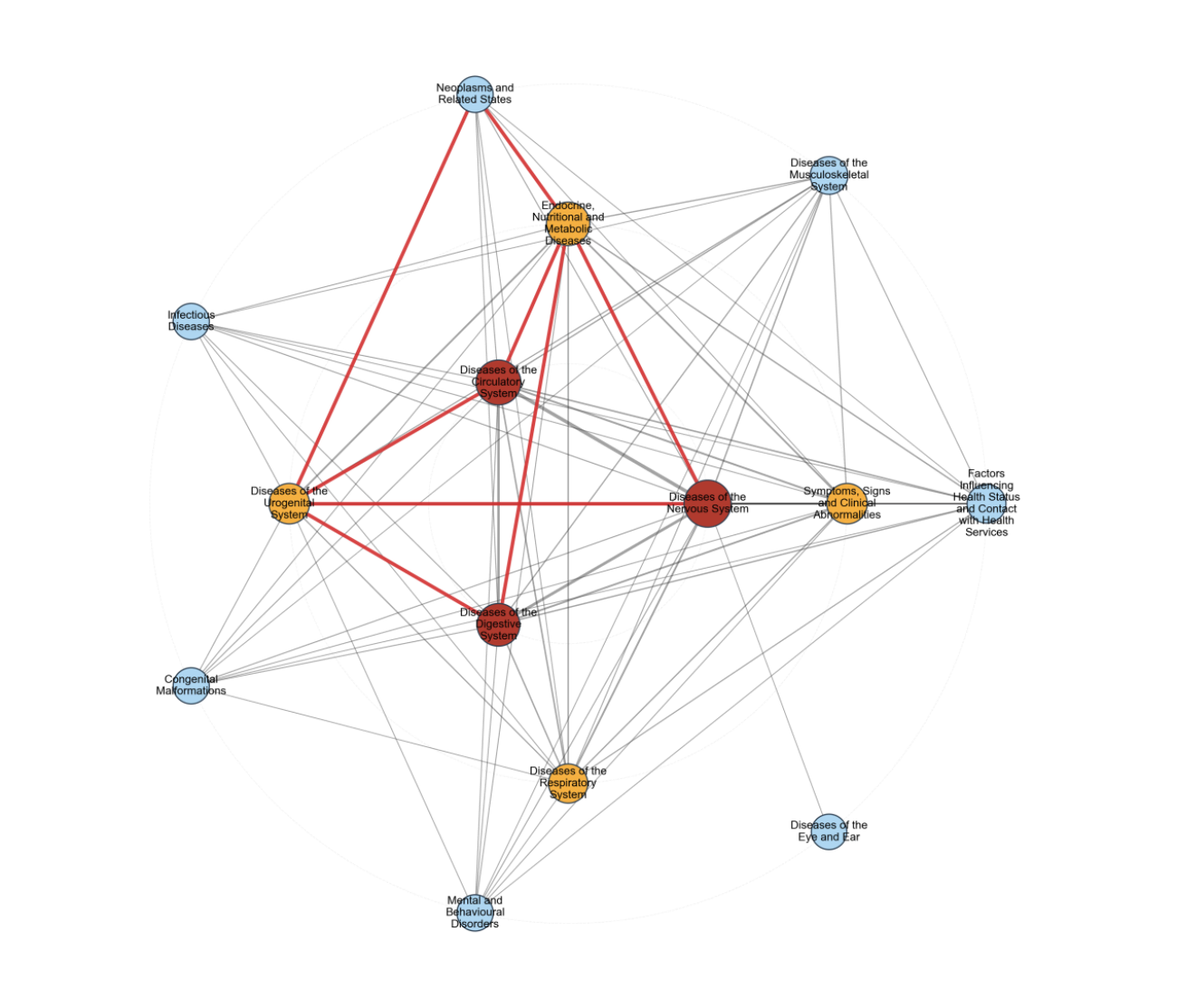
Disease-network density, a measure of connectedness, was 0.089 in young adults, 0.153 in middle-aged adults and 0.178 in older adults.
Independent replication, multicenter
Limit: Smoking, physical activity, medication exposure, and disease severity were not accounted for
Edited by Boris Djordjevic · AgingResearch.News
Researchers analyzed 73,023 electronic health records from adults at Xiangya Hospital in Changsha, China, in a retrospective cross-sectional study. They compared ages 18–44, 45–59 and 60 or older. They grouped diagnoses into 16 body systems and mapped which systems’ diseases occurred together.
Young adults had four dispersed disease clusters. In middle age, conditions involving metabolism—the body’s chemical processes—and the heart and blood vessels formed a central cluster. Older adults had a tightly connected core involving circulation, metabolism and the nervous system. The researchers also tested algorithms for predicting links between disease groups. They validated the framework in 1,500 patients from two hospitals in Jiangxi Province.
Why it matters
Managing several chronic conditions raises questions about how care should adapt at different ages. The researchers proposed using this framework to support care across body systems rather than one disease at a time.
Caveats
The cross-sectional design compared age groups; it could not show how disease patterns changed within individuals or establish future disease risk. The findings came from hospital patients in China, and the preprint has not been peer-reviewed.
From the paper
- Participants
The final analytical sample comprised 73,023 patients: young (n = 1,803, 2.5%), middle-aged (n = 3,575, 4.9%), and older (n = 67,645, 92.6%).
Quoted word for word from the full text on researchsquare.com.
The paper
Age-Stratified Multimorbidity Architectures at the Physiological System Level: An Integrated Network
Hunan University of Technology and Business
Research Square, Oct 24, 2026, Open access, Preprint, not peer-reviewed