Hospital deaths per stay rose among older patients in France
Death rates were 5.68% in 2023 and 5.62% in 2024, versus 5.15% in 2018 and 5.22% in 2019, but age- and sex-adjusted trends mostly declined.
Our read
Populations- Studied:
- Cohort study of hospitalized adults aged 65 years and older, against hospital stays in 2019
- What changed:
- Hospital deaths per stay rose from 5.22% in 2019 to 5.62% in 2024 among older patients
- The catch:
- Demographic shifts inflated crude mortality; age- and sex-standardized mortality declined across most groups
Editor of record: Boris Djordjevic · AgingResearch.News
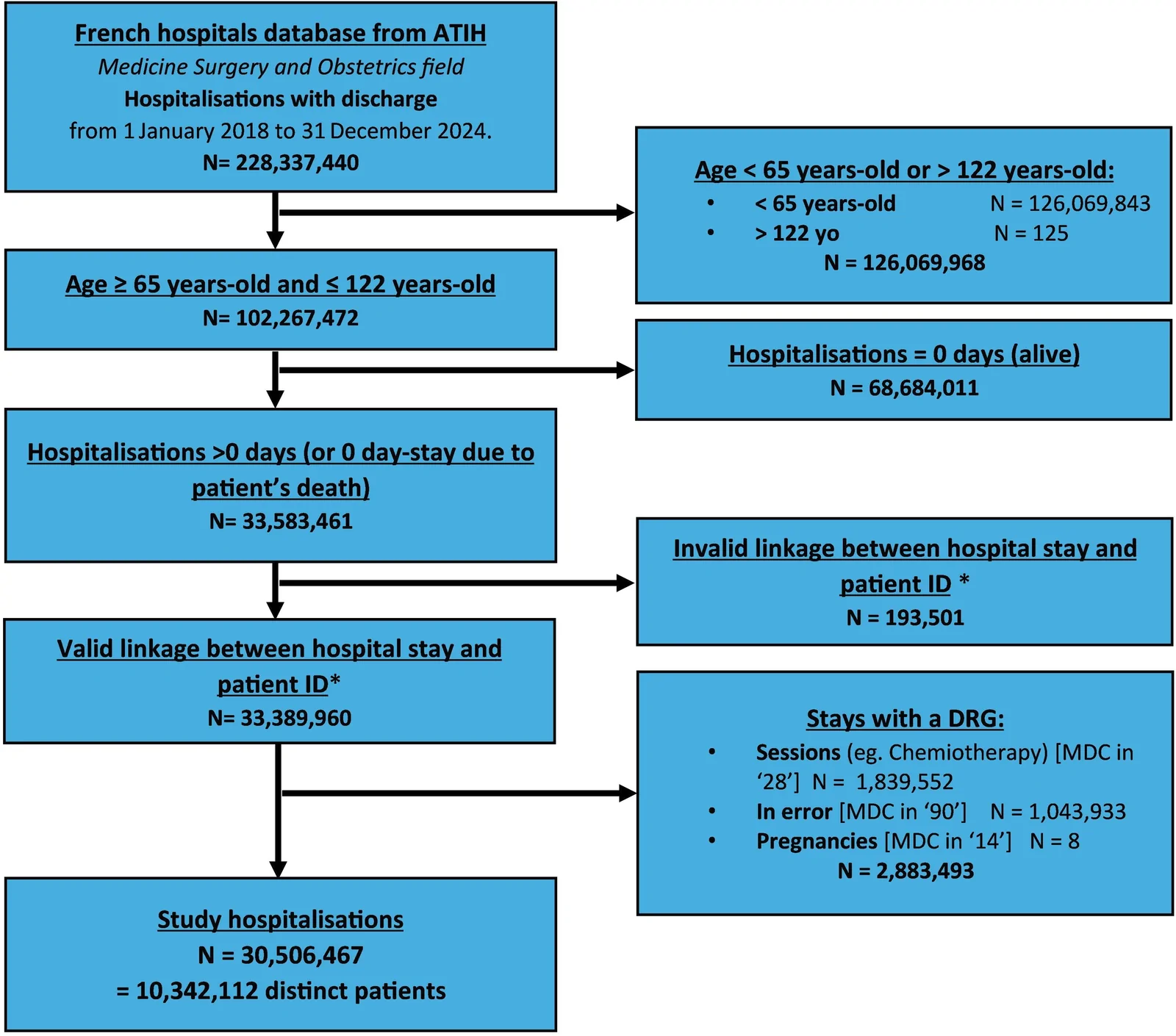
People aged 65 and older in France accounted for 30,506,467 acute-care hospital stays examined in a retrospective observational study covering 2018–2024. Researchers compared deaths during hospital stays before the pandemic, in 2018–2019, with those in 2023–2024. Across all seven years, 1,747,712 stays ended in death, an overall rate of 5.73%.
The share of hospital stays ending in death was higher after the pandemic. But rates calculated against the general French population, accounting for age and sex, declined in most age-and-sex groups. Associations with death also changed between periods. Dementia became more strongly associated with death, and the mortality gap between public and private hospitals widened.
Why it matters
Hospital mortality bears on how health systems respond to population aging. The authors call for targeted public health strategies to address persistent vulnerabilities in older people’s care.
Caveats
The authors note that other differences between patients and hospitals may have influenced the comparisons, leaving the pandemic’s role uncertain. The findings cover acute-care stays in people aged 65 and older, not rehabilitation, psychiatric or home-based hospital care.
Where the evidence stands
COVID-19 pandemic
- 176 independent labs in 41 countries
- 20 findings against
- Funders: National Institutes of Health and others
- 24 of 382 findings with company ties
Palliative care
- 6 independent labs in 5 countries
- Funders: Agency for Healthcare Research and Quality and 6 more
From the paper
- Limitation
However, our observational design limits causal inference and may be subject to residual confounding.
Quoted word for word from the full text on bmjpublichealth.bmj.com.
The paper
Centre National de la Recherche Scientifique
BMJ Public Health, Nov 6, 2026, Open access

Comments
Be the first to comment.