Sociodemographic and intersecting sociodemographic subgroups in relation to US adult tobacco use trajectories over a 10-year period: Analysis of Population Assessment of Tobacco and Health (PATH) data
Abstract
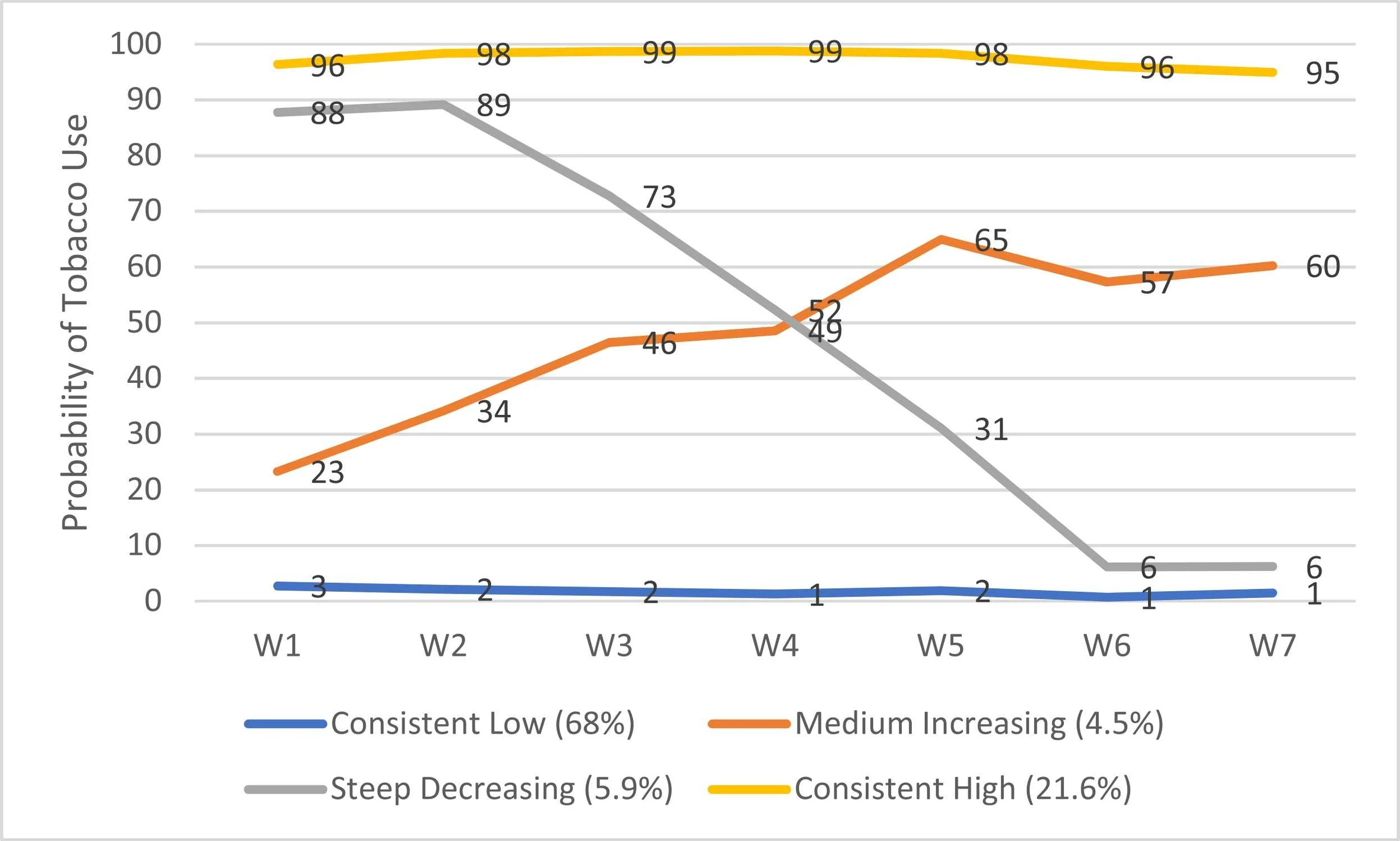
INTRODUCTION: Limited research has assessed tobacco use trajectories among subpopulations, particularly those representing intersecting minority identities, across adulthood. This study assessed tobacco use trajectories over 10 years among sociodemographic subgroups of US adults. METHODS: We analyzed 7 waves of data (2013-2022) from the Population Assessment of Tobacco and Health (PATH). General growth mixture modeling assessed trajectories of any past-month use of cigarettes, e-cigarettes, cigars, hookah, and smokeless tobacco. Multivariable multinomial logistic regression assessed sociodemographics and sociodemographic interactions in relation to trajectory. RESULTS: Four trajectories were identified: "consistently low" (68.0% of participants) with low prevalence over time (0.7%-2.7 "consistently high" (21.6%) with 95-99% using at each wave; "medium increasing" (4.5%) which increased from 23% using at W1-60% at W7; and "steep decreasing" (5.9%) which decreased from 88% using at W1-6% at W7. Factors associated with being in the latter 3 trajectories vs. "consistently low" included being younger, male, sexual minority (SM), Black, and less educated. Factors associated with "steep decreasing" or "consistently high" vs. "medium increasing" included being older and White vs. Black; being male, non-Hispanic, and less educated was also associated with "consistently high". Factors associated with "consistently high" vs. "steep decreasing" included being older, non-Hispanic, and less educated. Significant interactions indicated certain intersecting identities (e.g., female and SM, SM and Black, Black/another race and Hispanic) more likely showed the latter 3 trajectories. CONCLUSION: Tobacco prevention and intervention efforts must attend to sociodemographic profiles of adults at greatest risk for persistent or escalating tobacco use.
The paper
George Washington University
Drug and Alcohol Dependence, Oct 10, 2026