Hydroxygenkwanin Identified in Rehmanniae Radix Praeparata-Corni Fructus Ameliorates Postmenopausal Osteoporosis via Modulation of the AGE-RAGE Signaling Pathway
Abstract
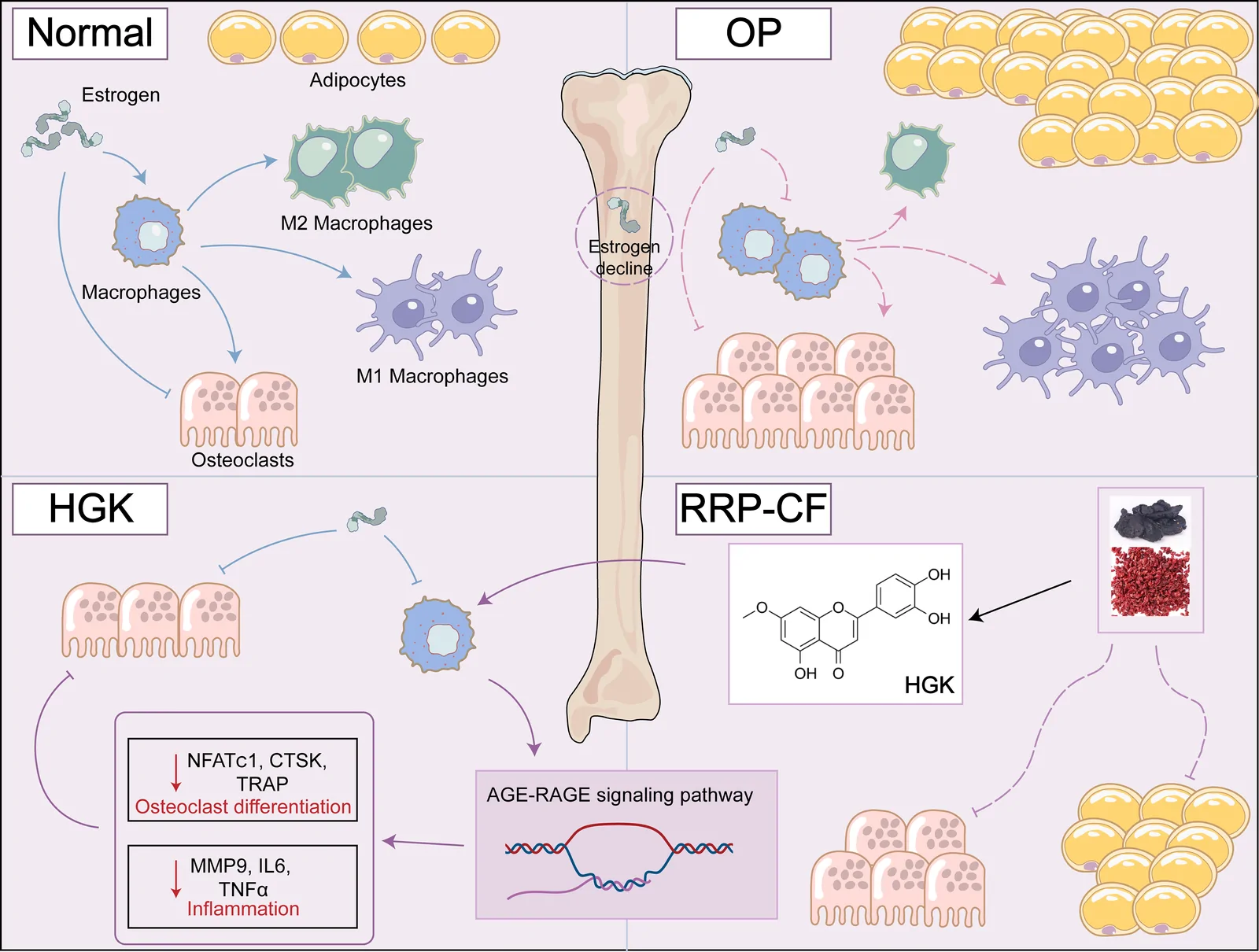
BACKGROUND: Osteoporosis (OP) is a metabolic bone disease marked by reduced bone mass and compromised microarchitecture, increasing fragility fracture risk. The traditional Chinese herbal pair Rehmanniae Radix Praeparata-Corni Fructus (RRP-CF) is frequently used for OP, but its mechanism remains unclear. METHODS: Network pharmacology, UHPLC-HRMS, molecular docking, and molecular dynamics simulations were integrated to identify the potential active components of RRP-CF and to predict the potential targets and related signaling pathways underlying its anti-osteoporotic effects. These predictions were further validated through in vitro (using 25 and 50 µM hydroxygenkwanin (HGK)) and in vivo experiments in ovariectomized (OVX) rats (using 10 and 20 mg/kg HGK). RESULTS: UHPLC-HRMS identified HGK as one of the detectable components of RRP-CF. A total of 66 common targets between RRP-CF and OP were screened out by network pharmacology; Protein-Protein Interaction (PPI) network analysis showed that estrogen receptor 1 (ESR1), tumor protein p53 (TP53), tumor necrosis factor (TNF), signal transducer and activator of transcription 3 (STAT3), and prostaglandin-endoperoxide synthase 2 (PTGS2) were the key targets. Gene Ontology enrichment suggested that RRP-CF-associated targets were mainly involved in inflammatory response, and the advanced glycation end products-receptor for advanced glycation end products (AGE-RAGE) signaling pathway was identified as a critical pathway. In vivo experiments confirmed that RRP-CF could improve bone microstructure and collagen content, as evidenced by increased BMD (from 106.58 ± 11.09 mg/cm³ in the OVX group to 188.35 ± 10.18 mg/cm³ in the 10 mg/kg HGK-treated group) and bone volume/tissue volume (BV/TV) (from 0.13 ± 0.02 to 0.29 ± 0.05). Mechanistically, HGK treatment downregulated RAGE expression in OVX rat bone tissue (P = 0.0208) and receptor activator of nuclear factor-κB ligand (RANKL)-induced RAW264.7 cells (P = 0.0005), and suppressed osteoclast-related proteins including nuclear factor of activated T-cells cytoplasmic 1 (NFATc1) (P = 0.0061 in cells) and cathepsin K (CTSK) (P < 0.0001 in rats; P = 0.0006 in cells). Furthermore, rescue experiments using the RAGE inhibitor FPS-ZM1 suggested that the effects of HGK were associated with modulation of RAGE-related signaling. CONCLUSION: Our findings indicate that RRP-CF can inhibit bone loss in OVX rats, and suggest that HGK, as a potential active constituent of RRP-CF, may exert anti-osteoporotic effects through modulation of the AGE-RAGE pathway and downregulation of osteoclast-related proteins including p53, p-AKT, NFATc1 and CTSK. These findings provide a preliminary mechanistic basis for developing novel OP therapeutic regimens, though further pharmacokinetic and safety studies are warranted.
The paper
First College of Clinical Medicine
Journal of Inflammation Research, 6 Oct 2026
