Poorer very high-frequency hearing linked to weaker brain responses
An observational study linked impaired hearing above 8 kilohertz to smaller brain responses to speech on both sides of the brain.
NeuroImage
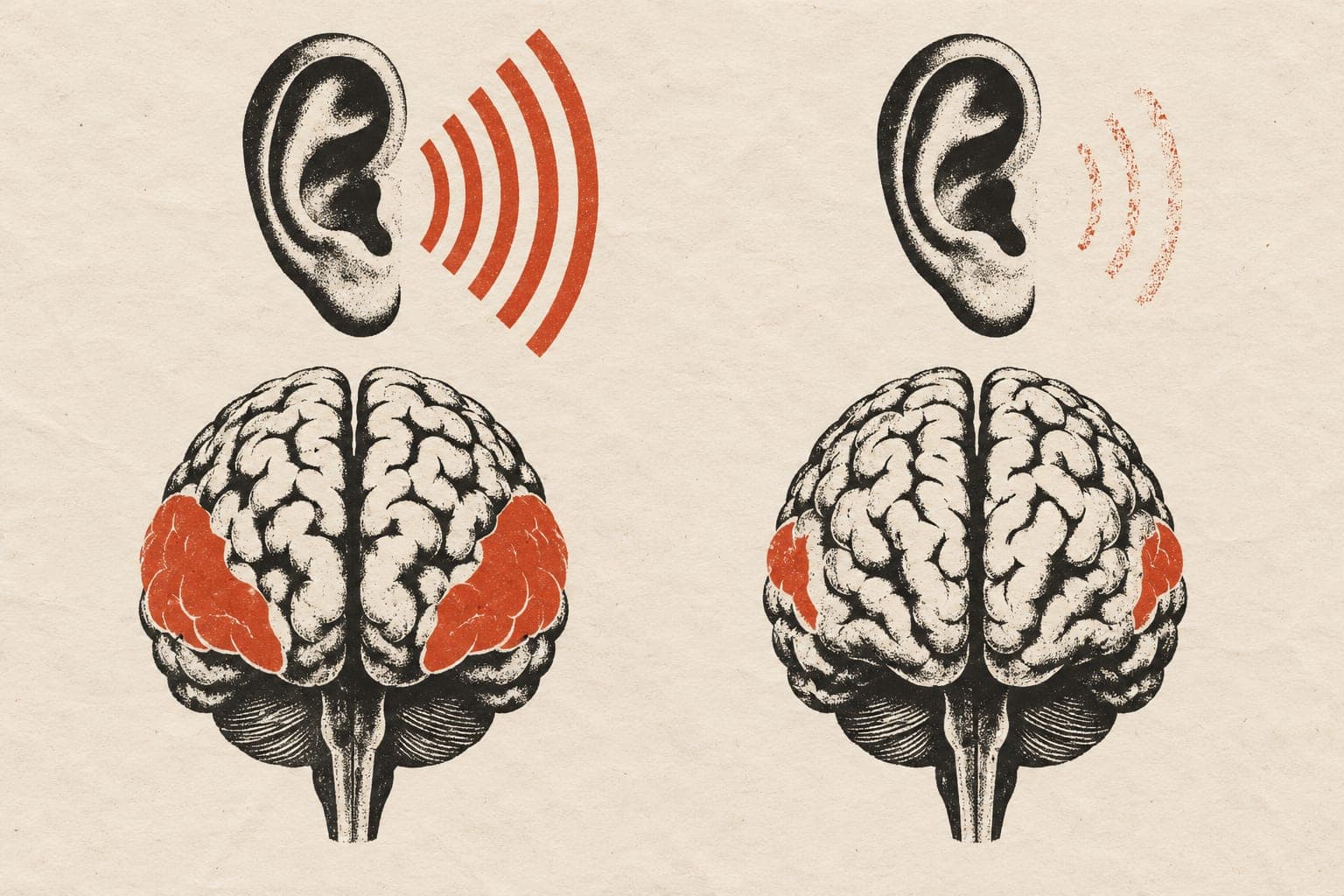
In an observational study, people with impaired hearing for sounds above 8 kilohertz had smaller brain responses to speech than those with better hearing in this range. These are very high-pitched sounds. Researchers used magnetoencephalography, a method that records magnetic signals from brain activity. They used a speech task designed to probe attention, memory and recognition.
The smaller responses appeared in both the left and right sides of the brain. The authors suggested that sound above 8 kilohertz contributes to speech understanding. They called for this hearing range to receive more attention in hearing tests and hearing-aid design.
Why it matters
Loss of hearing at these very high frequencies is a hallmark of age-related hearing loss and can begin early in life. Routine hearing tests mostly stop at 8 kilohertz, so this deficit frequently goes undetected.
Caveats
The observational design cannot establish that poorer hearing caused the differences in brain responses or affected speech understanding.
- Extended high-frequency hearing loss
- Auditory brainstem response amplitude
- Auditory evoked cortical magnetic field response amplitude
- Humans
The paper
Extended high frequency hearing influences cortical response amplitudes to speech
Show 11 more authors
Etienne Gaudrain, Deniz Başkent, Sarah Verhulst, Csaba Harasztosi, Wibke Singer, Manuel S Malmierca, Markus Siegel, Ernst Dalhoff, Stephan M Wolpert, Christoph Braun, Lukas Rüttiger,University of Tübingen
NeuroImage · 5 Oct 2026