AI model predicts Alzheimer's conversion across cohorts
In 101 people with mild cognitive impairment, the model predicted conversion with an AUC of 0.72 and mirrored rates of brain atrophy and cognitive decline.
Our read
Biomarkers- Studied:
- Preprint: computational study (101 mci participants, cohort study, independent replication)
- Stake:
- An author works for BrainAxis.
Editor of record: Boris Djordjevic · AgingResearch.News
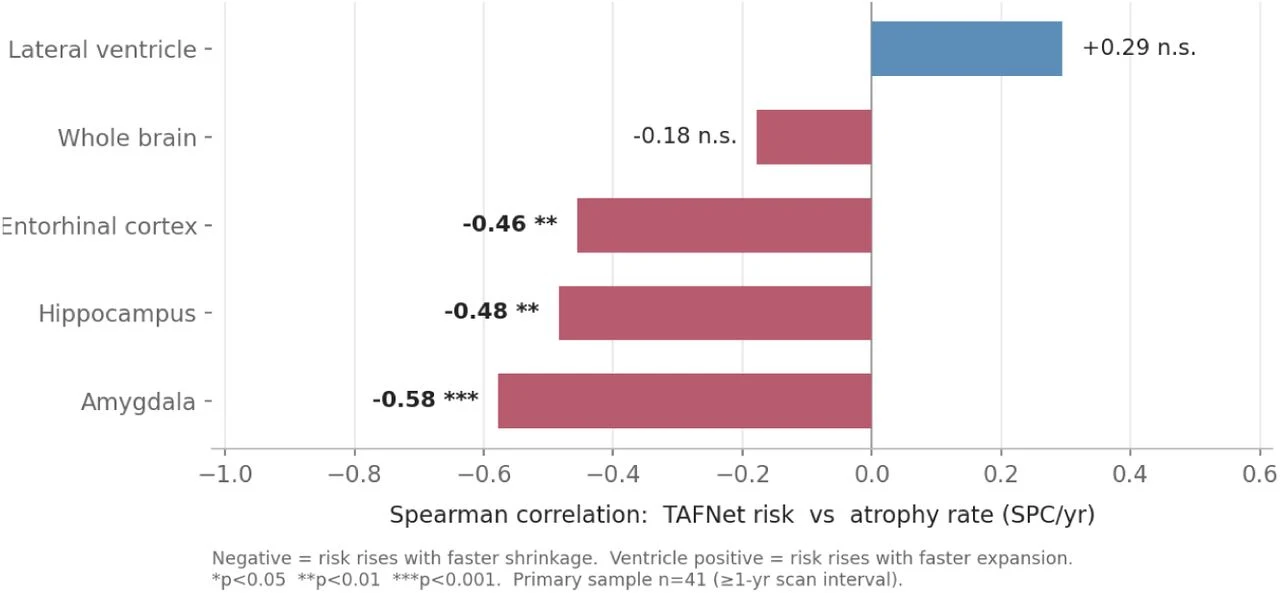
In a study of 101 people with mild cognitive impairment from the OASIS-3 dataset, researchers tested whether an artificial intelligence model could predict progression to Alzheimer's disease in an independent cohort. The model, called TAF-Net, was trained on the separate Alzheimer's Disease Neuroimaging Initiative dataset and applied without retraining. Higher predicted risk tracked faster brain atrophy specifically in medial-temporal regions, along with steeper multi-year cognitive decline and lower baseline resting-state functional connectivity in salience and default-mode hubs. In external validation, the model discriminated participants who progressed to Alzheimer's disease with an area under the curve of 0.72. Brain atrophy statistically accounted for this prognostic signal. However, while rank discrimination transferred between cohorts, probability calibration failed: participants in the lowest two risk tertiles were assigned near-zero conversion probabilities but actually converted at a 15% rate.
Why it matters
Validating predictive models across distinct patient populations confirms whether computational biomarkers capture bona fide biological processes of neurodegeneration rather than cohort-specific artifacts.
Caveats
The findings were published as a preprint and have not yet undergone peer review. In addition, the imaging subsamples were limited to about 40 participants, and the tool requires recalibration before its scores can serve as individual risk probabilities.
From the paper
- Participants
The analysis cohort comprised 101 individuals with mild cognitive impairment (MCI; global Clinical Dementia Rating [CDR] = 0.5) at the baseline MRI, each with at least two longitudinal T1-weighted (T1w) structural MRI sessions.
- Follow-up
In the full cohort (n = 101; median follow-up 8.8 years) …
- Result
Converters declined markedly faster than stable participants: MMSE -1.49 vs -0.21 points/yr (difference -1.28, 95% CI -2.16 to -0.51) and CDR-SB +1.46 vs +0.27 per year (difference +1.19, 95% CI +0.74 to +1.70); both Mann-Whitney p < 0.0001.
- Limitation
The structural and functional analyses rest on modest samples (n = 41 and n = 40) determined by imaging completeness, limiting power; no individual functional parcel survived whole-brain correction …
Quoted word for word from the full text on medRxiv.
- Mild cognitive impairment
- Alzheimer's disease
- Clinical Dementia Rating Sum of Boxes
- Mini-Mental State Examination
- TAF-Net risk score
- Humans
The paper
BrainAxis Pty Ltd; Swinburne University of Technology
medRxiv, Sep 10, 2026, Open access, Preprint, not yet peer-reviewed


Comments
Be the first to comment.