Blood protein may link smoking with heart disease
Genetic analyses estimated that the protein might account for 6.35% of the association between starting smoking and heart disease.
Our read
Biomarkers- Studied:
- Mendelian randomization in individuals of European ancestry (Dose-response, independent replication)
- What changed:
- ASGR1 explained 6.35% of smoking's effects on ischemic heart disease
- The catch:
- Body mass index may confound the association between smoking and ASGR1 levels
- In the record:
- The 1,930th paper on smoking with results in people; 5,069 on record in all.
Editor of record: Boris Djordjevic · AgingResearch.News
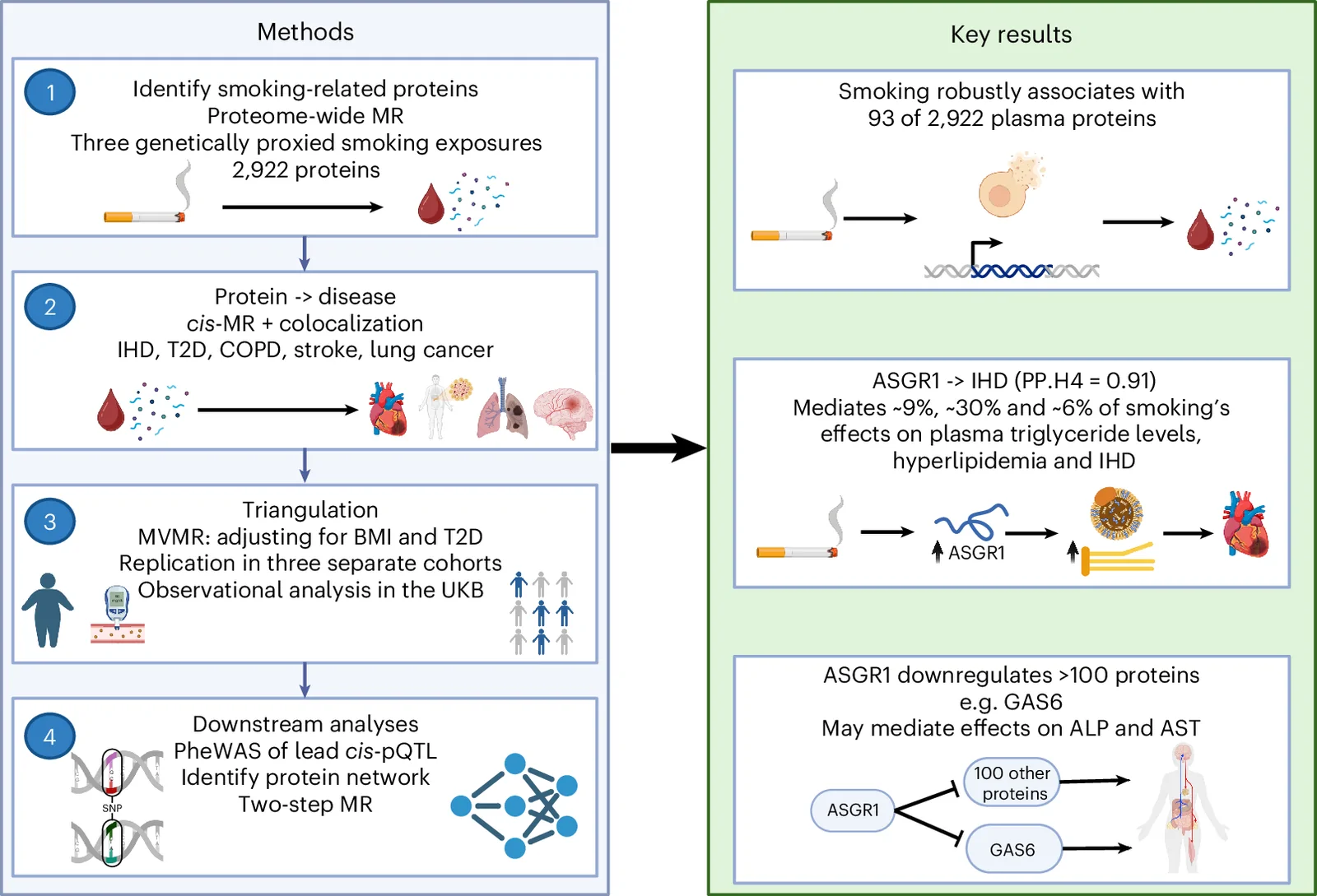
In people of European ancestry, researchers analyzed genetic links between smoking, blood proteins and ischemic heart disease, which involves reduced blood flow to the heart. They used Mendelian randomization, a method that uses genetic differences as indicators of exposures such as smoking or protein levels.
Data on starting smoking came from 2,669,029 people, and protein measurements came from 34,557 UK Biobank participants. Heart disease data included 322,987 people with the disease and 1,441,499 controls. Genetically predicted smoking was associated with 93 of 2,922 blood proteins, including higher levels of the blood protein asialoglycoprotein receptor 1 (ASGR1). Higher genetically predicted ASGR1 levels were linked to higher heart disease risk. The authors estimated that ASGR1 accounted for 6.35% of the association between starting smoking and heart disease.
Why it matters
The biological links between smoking and ischemic heart disease remain incompletely understood, leaving open how tobacco exposure contributes to this age-related illness.
Caveats
Possible genetic effects through other pathways complicate the mediation estimate. The residual association in never-smokers was not statistically significant but was consistent with such effects, potentially involving body mass index; the findings concern European-ancestry populations.
From the paper
- Participants
The resulting datasets included 322,987 cases and 1,441,499 controls for IHD; 242,283 cases and 1,569,734 controls for T2D; 161,613 cases and 1,252,808 controls for COPD; 83,293 cases and 1,654,140 controls for ischemic stroke; and 42,331 cases and 491,047 controls for lung cancer.
- Result
… BMI (β = 0.36, 95% CI: 0.31, 0.41, P = 1.34 × 10−46) and T2D (0.08, 95% CI: 0.06, 0.11, P = 1.21 × 10⁻¹⁰) were associated with higher ASGR1 levels using univariable MR (Fig. 5).
Results, Vascular risk factor MVMR and replication (stage 3)
Quoted word for word from the full text on nature.com.
The paper
University of Oxford
Nature Cardiovascular Research, Sep 22, 2026, Open access


Comments
Be the first to comment.