Skin oil differed more sharply with age after 40 in women
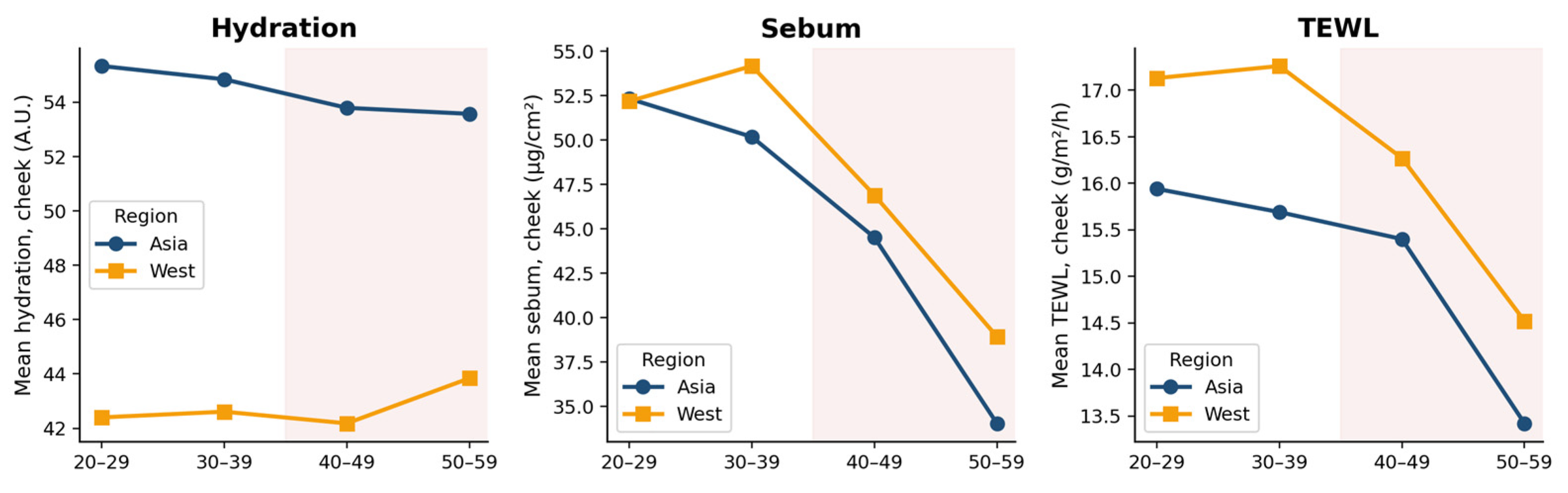
Skin oil was 34.9% lower in Asian women and 25.4% lower in Western women aged 50–59 than at 20–29, while hydration differed by less than 3.5%.
Multicenter
Limit: Skincare use, diet, and sun exposure were unrecorded and could confound age differences
Edited by Boris Djordjevic · AgingResearch.News
In 7,743 women aged 20–59 across 12 countries, a cross-sectional study compared standardized cheek measurements of skin oil, hydration and water loss through the skin. Participants included 5,274 Asian and 2,469 Western women. Researchers tested whether the relationship between age and each measure changed at 40.
The link between older age and lower skin oil, called sebum, was steeper from 40 onward in both groups. This pattern held after accounting for country and appeared at two other facial sites. Researchers found no change at 40 in how hydration varied with age. Resting water loss through the skin decreased rather than increased with age.
Why it matters
The authors called for studies that follow women over time and measure hormones to test whether the midlife skin-oil pattern reflects menopause.
Caveats
The study compared age groups rather than following individual women over time, so it cannot establish how a woman's skin changed as she aged. The comparisons also do not establish whether menopause explains the pattern.
From the paper
- Participants
The analytic sample comprised 7743 women (Asia, n = 5274; West, n = 2469), with almost equal numbers in each age decade (Section 2.1); the group aged 40–59 years included 2644 Asian and 1235 Western women.
- Result
In Western women, the slope changed from −0.008 to −0.770 µg/cm/year (slope change β4 = −0.762, 95% CI −1.342 to −0.182, p = 0.010; Table 1); in Asian women, it changed from −0.149 to −1.404 µg/cm/year (slope change β4 + β7 = −1.256, 95% CI −1.651 to −0.860, p < 0.001).
Results, 3.3. Piecewise Regression of Sebum, Hydration, and TEWL on Age Before and After Age 40
- Limitation
First, the design is cross-sectional, so age patterns reflect differences between age groups rather than within-individual change, and cohort effects cannot be excluded.
Quoted word for word from the full text on mdpi.com.
The paper
Ewha Womans University; Classone Clinic
Cosmetics, Oct 22, 2026, Open access, CC BY