Blistering disease grew more common among German adults
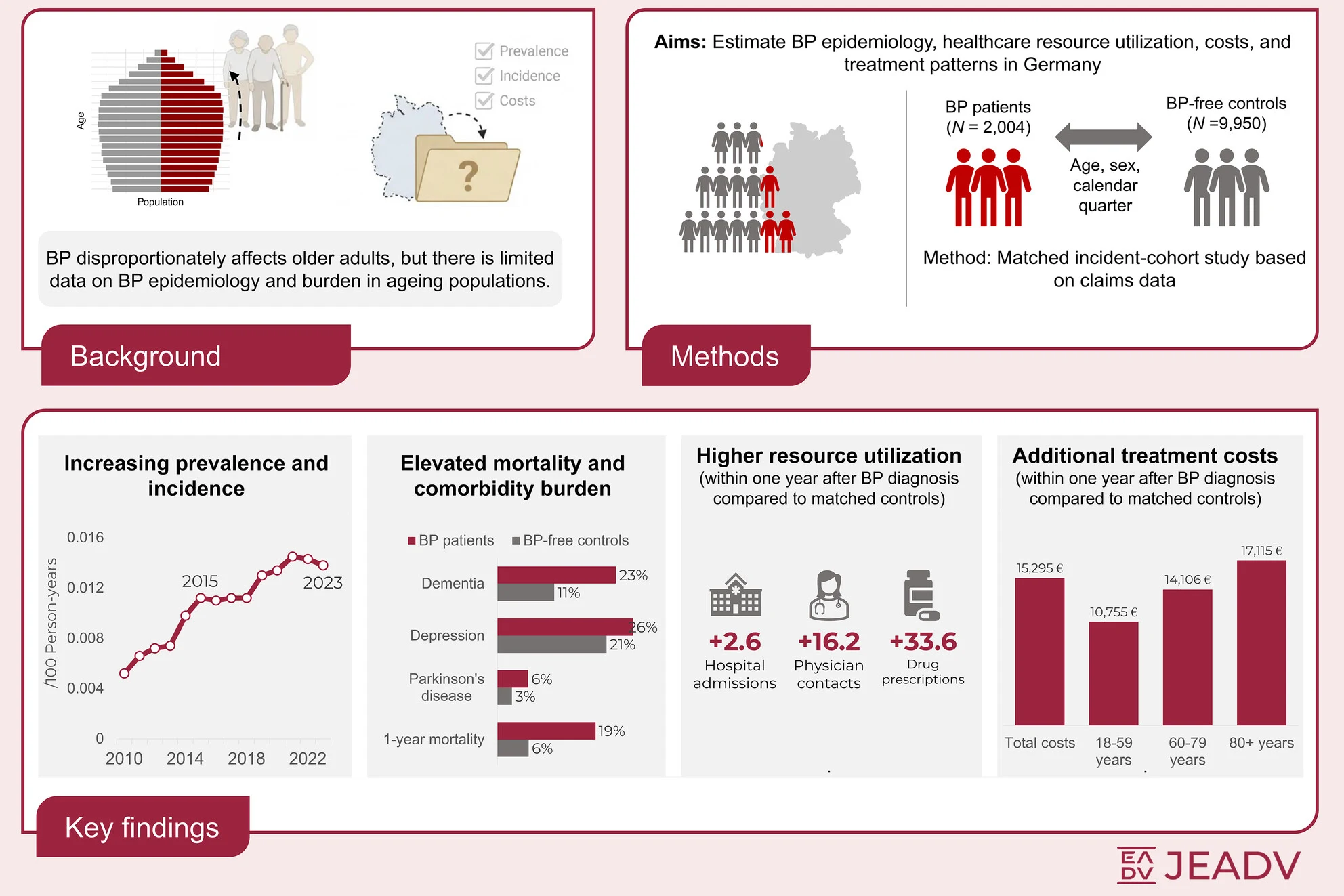
The proportion affected rose from 0.05 to 0.14 per 1,000 adults between 2010 and 2023, most steeply among those 80 and older.
Our read
Populations- Studied:
- Cross-sectional study of statutorily insured adults in Germany, against German adults in 2010
- What changed:
- Bullous pemphigoid prevalence in Germany rose from 0.005% in 2010 to 0.014% in 2023
- The catch:
- Improved diagnostic tools could inflate the apparent rise in disease
- In the record:
- The 9th paper on bullous pemphigoid with results in people; 16 on record in all.
- Why it’s aging research:
- It measures an outcome that worsens with age.
Editor of record: Boris Djordjevic · AgingResearch.News
German adults aged 18 and older were studied in an observational analysis of health insurance records covering 6.8 million people from 2010 to 2023. Bullous pemphigoid, a blistering disease in which the immune system attacks the body’s own tissue, became more common across all age groups.
The researchers also followed 2,004 newly diagnosed patients and 9,950 controls matched by age, sex and calendar quarter for up to two years. Both groups averaged 76 years of age, and nearly half were women. Within one year, 18.8% of patients died, compared with 6.0% of controls. Mean healthcare costs during the first year were €20,881 per patient versus €5,586 per control, mainly reflecting hospital care. Patients also had more other illnesses than controls.
Why it matters
Bullous pemphigoid primarily affects older adults, so tracking its burden can help inform healthcare planning as populations age.
Caveats
Diagnoses came from insurance claims, and deaths were inferred from insurance disenrollment; differences in underlying health not captured by adjustment could have contributed to the mortality gap. The analysis excluded people under 18 and those with incomplete insurance coverage.
Where the evidence stands
Azathioprine
- 1 lab in 1 country
- 53 trials, 10 with no results posted
- Funders: Ministry of Emergency Management of the People's Republic of China and 2 more
Corticosteroids
- 43 independent labs in 21 countries
- 4 findings against
- Funders: Aotearoa Foundation and others
- 5 of 51 findings with company ties
From the paper
- Participants
The analytic cohort comprised 2005 patients with incident BP.
- Follow-up
Cases and controls were followed for up to 2 years or until death, disenrollment, incident BP in a control or December 31, 2023, whichever occurred first.
- Result
BP patients exhibited a higher comorbidity burden than matched controls (mean Elixhauser index 5.0 vs. 3.8) and increased mortality (1-year mortality: 18.8% vs. 6.0%; adjusted incidence rate ratio (IRR) 3.09, 95% CI: 2.71–3.52).
- Events by group
BP patients exhibited a higher comorbidity burden than matched controls (mean Elixhauser index 5.0 vs. 3.8) and increased mortality (1-year mortality: 18.8% vs. 6.0%; adjusted incidence rate ratio (IRR) 3.09, 95% CI: 2.71–3.52).
Quoted word for word from the full text on onlinelibrary.wiley.com.
The paper
Increased incidence and healthcare burden of bullous pemphigoid: A population‐based cohort study
Sanofi-Aventis Deutschland GmbH Berlin Germany; Lübecker Institute of Experimental Dermatology University of Lübeck Lübeck Germany
Journal of the European Academy of Dermatology and Venereology, Nov 6, 2026, Open access, CC BY-NC

Comments
Be the first to comment.