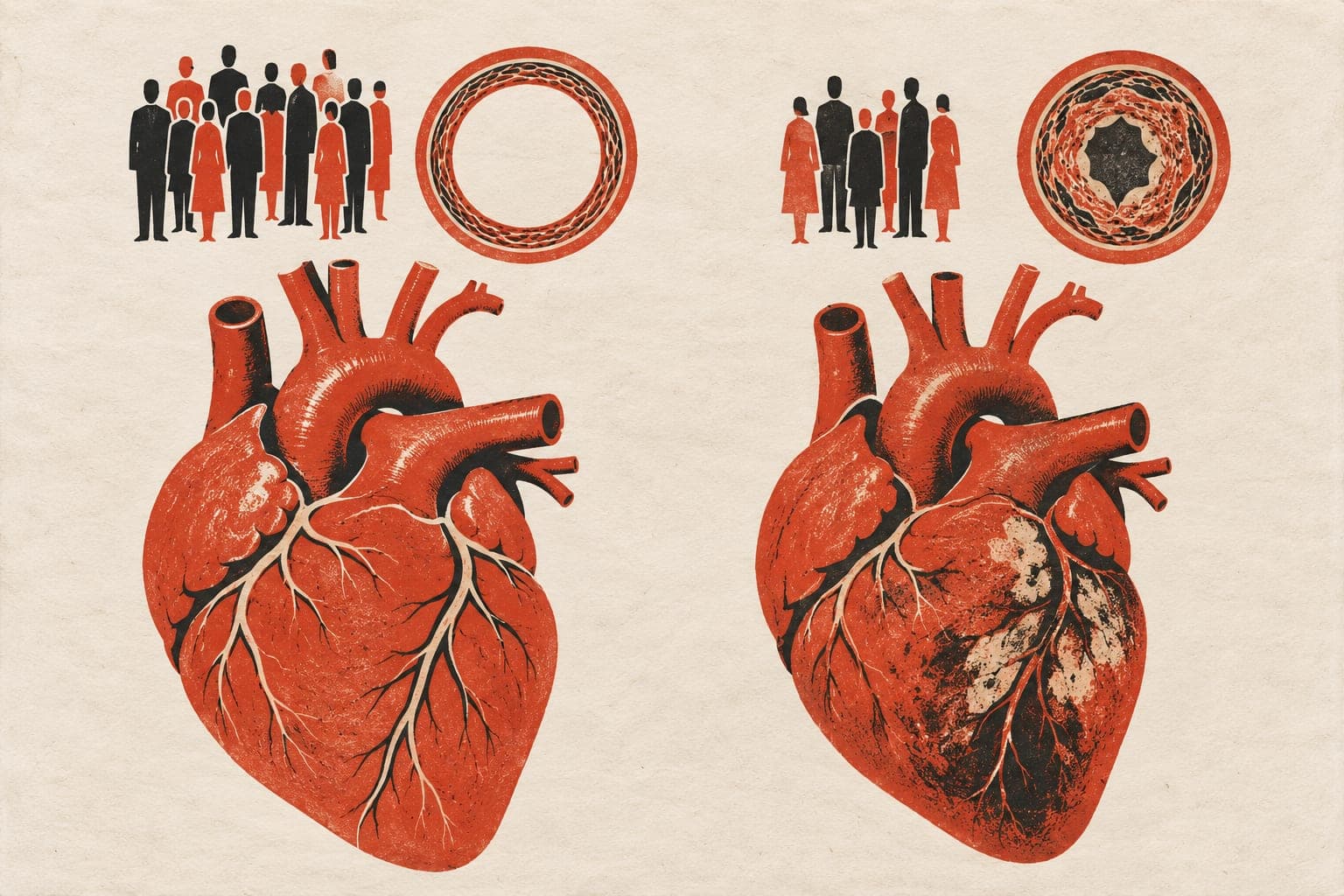
Mental health adds little to cardiovascular risk prediction
In a 12-year study of 36,859 adults, high cardiovascular health scores were linked to lower death rates, but adding depression scores did not meaningfully improve risk prediction.
Limit: Mental health was represented only by depressive symptoms from a brief questionnaire
Edited by Boris Djordjevic · AgingResearch.News
In an observational cohort study across 12 Chinese provinces, researchers followed 36,859 adults aged 35 to 70 years, with an average age of 50.5 years, for a median of 12.0 years. They evaluated Life’s Essential 8, an eight-part measure covering nicotine exposure, diet, physical activity, sleep, body mass index, blood lipids, blood glucose, and blood pressure. They also tested Life’s Crucial 9, which adds depressive symptoms to the score.
During follow-up, 1,914 participants died and 2,881 had major cardiovascular events. Across categories of Life’s Crucial 9, standardized death rates were 7.80 per 1,000 person-years in the low group, 3.93 in the moderate group, and 2.76 in the high group. Compared with low scores, high scores were associated with lower risk of death (hazard ratio 0.40) and major cardiovascular disease (hazard ratio 0.34). However, adding depressive symptoms yielded negligible improvement in risk prediction beyond the original eight components.
Why it matters
Cardiovascular disease and death rates rise steadily with age. Evaluating whether adding psychological health to physical metrics refines risk estimates helps clarify which tools best capture vulnerabilities that shorten healthy lifespan.
Caveats
The observational design cannot establish cause and effect, and depressive symptoms were assessed using a brief questionnaire. The findings come from adults aged 35 to 70 across 12 provinces in China and may not apply to other age groups or populations.
The paper
The First Affiliated Hospital of Nanchang University; Fuwai Hospital
ESC Congress 2026 Abstract, Oct 26, 2026
Presented at ESC Congress 2026