Brain stimulation affected sequence learning differently by age
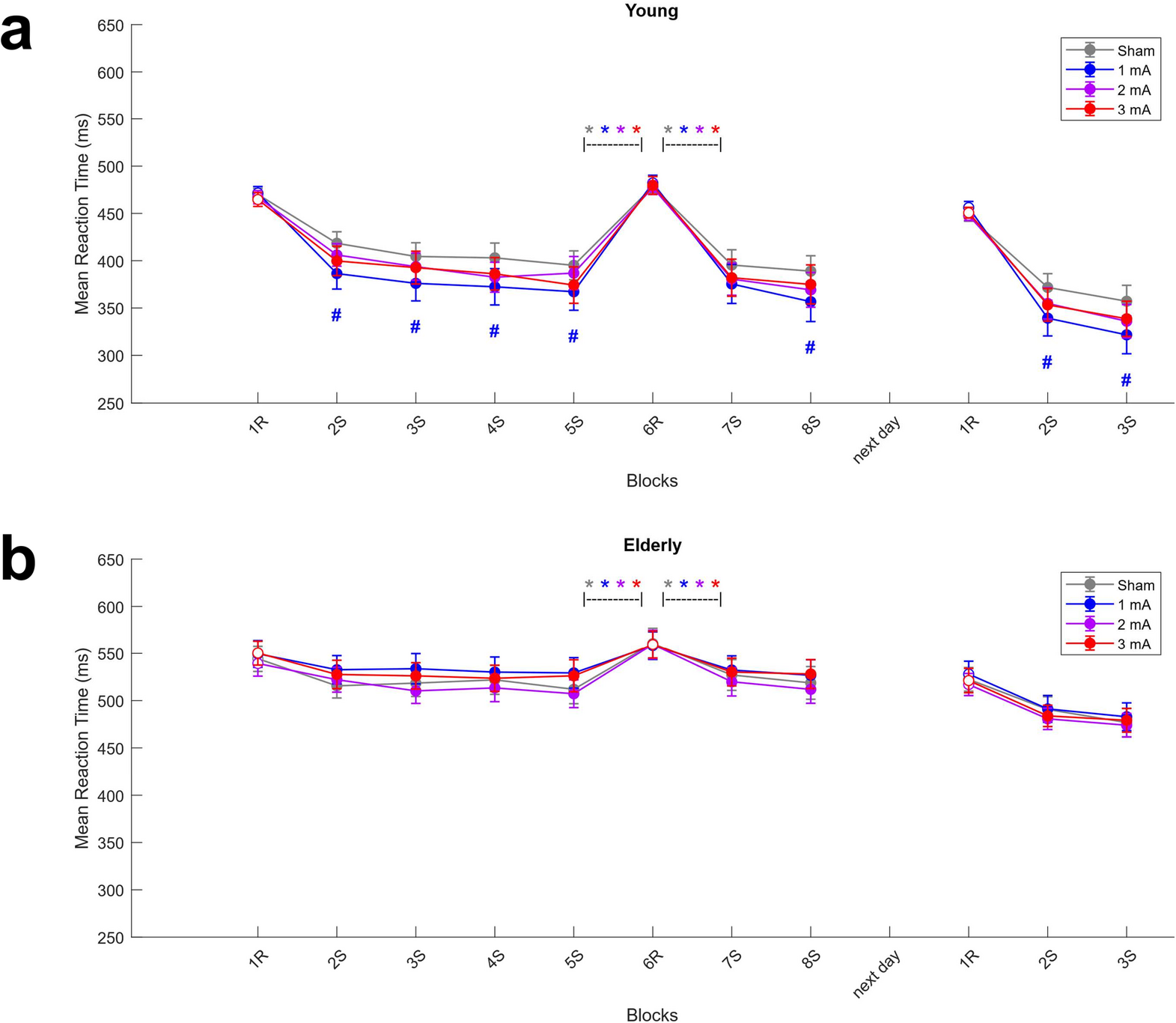
In a 96-person crossover trial, stimulation at 1 milliamp improved sequence learning in young adults but reduced it in older adults.
Our read
Interventions- Studied:
- Randomized trial in 96 healthy young and older adults, next day, against sham stimulation (Double-blind, sham-controlled, dose-response)
- What changed:
- At 1 milliamp, sequence learning improved in young adults but was lower in older adults compared with sham stimulation
- The catch:
- Recall was measured the next day, leaving longer-term retention unknown
Editor of record: Boris Djordjevic · AgingResearch.News
Ninety-six healthy participants—48 young adults and 48 older adults—completed a movement-sequence reaction-time task in a randomized, double-blind, counterbalanced crossover trial. During learning, they received sham stimulation or transcranial direct current stimulation—a weak electrical current applied through the scalp—at 1, 2 or 3 milliamps.
Both age groups learned sequences across conditions. In young adults, 1 milliamp improved learning by shortening reaction times; higher intensities offered no significant benefit over sham. In older adults, stimulation did not change overall task performance compared with sham, but learning of the specific sequence was lower at 1 milliamp. Young adults’ performance remained unchanged between learning and next-day recall. After active stimulation, older adults responded faster in sequence blocks at recall than during learning, indicating that learning consolidated between sessions.
Why it matters
Efforts to support motor learning in older adults must account for age-related differences in the brain’s capacity to adapt. The authors call for age-adapted stimulation protocols in research and clinical applications.
Caveats
Recall was tested the next day, leaving longer-term retention open. All 96 participants were healthy, so the findings may not extend to people with neurological conditions.
Where the evidence stands
Transcranial direct current stimulation
- 94 independent labs in 27 countries
- 44 findings against
- Funders: National Institute on Aging and others
- 10 of 326 findings with company ties
Comments
Be the first to comment.