Frailty checks had similar links to repeated falls in older adults
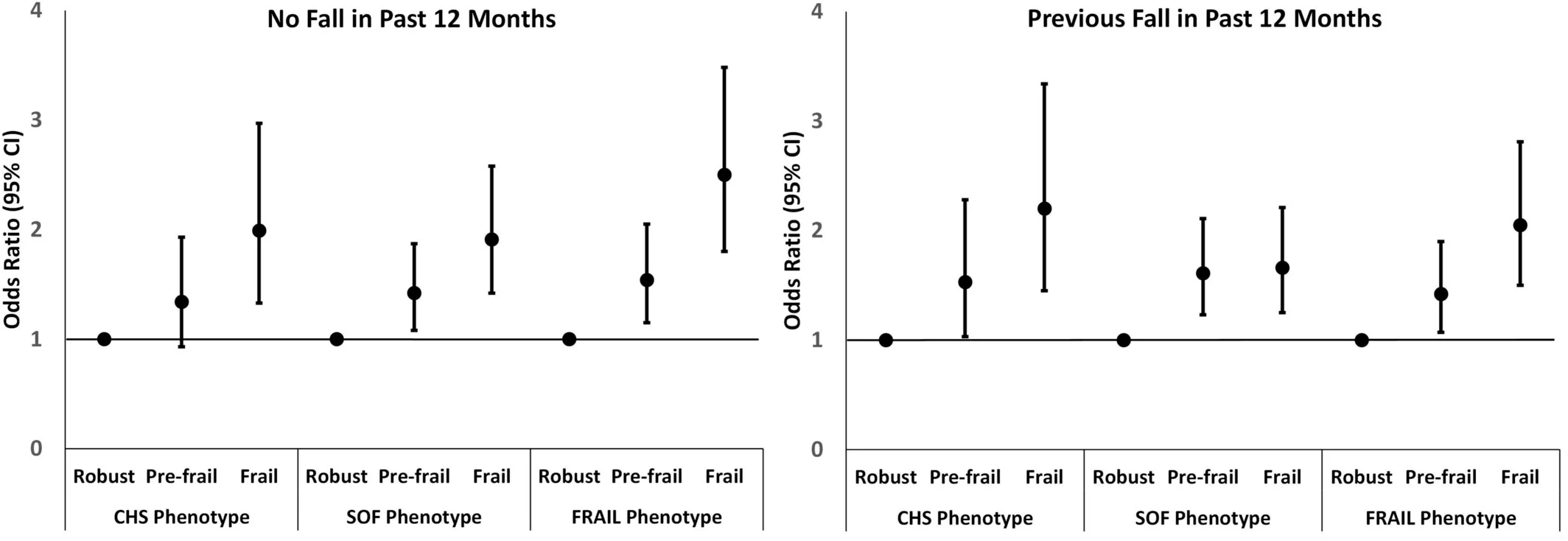
Compared with peers with no frailty signs, frail women had 2.2 to 2.8 times the odds of repeated falls; frail men had 2.6 to 3.5 times the odds.
Our read
Biomarkers- Studied:
- Cohort study of 14,596 community-dwelling older adults, 12-month, against robust older adults
- What changed:
- Repeated-fall odds were higher in frail than robust adults across instruments: odds ratios 2.2 to 2.8 (women), 2.6 to 3.5 (men)
- The catch:
- Harmonizing CHS and FRAIL measurements across cohorts lost information
Editor of record: Boris Djordjevic · AgingResearch.News
The 14,596 community-dwelling older adults in this prospective study included 7,593 women averaging 80.3 years and 7,003 men averaging 78.1 years. Researchers combined data from four cohort studies. They compared one more complex frailty assessment with two simpler ones, classifying participants as having no frailty signs, pre-frailty or frailty.
Over the following year, 16.1% of women and 14.6% of men reported at least two falls. All three assessments showed similar links between frailty and repeated falls. Frailty and pre-frailty were each associated with higher odds of repeated falls after accounting for other fall risk factors. The links appeared in both sexes, with or without a history of falling.
Why it matters
The authors suggest that simpler frailty assessments may help clinics with limited time and space identify older adults at increased risk of falls.
Caveats
Falls were self-reported through questionnaires, making the results dependent on participants’ recall. The findings concern community-dwelling older adults, not people living in care facilities.
From the paper
- Participants
The study population of community-dwelling adults included 7593 women (mean age 80.3 years) and 7003 men (mean age 78.1 years) (Table 1).
Quoted word for word from the full text on agsjournals.onlinelibrary.wiley.com.
- Falls
- Cardiovascular Health Study frailty phenotype
- FRAIL Scale
- Study of Osteoporotic Fractures frailty phenotype
- Humans
The paper
School of Public Health University of Minnesota Minneapolis Minnesota USA
Journal of the American Geriatrics Society, Nov 27, 2026, Open access, CC BY


Comments
Be the first to comment.