Brain inhibition shifts with age in gene-deficient female mice
Experiments in female mice with a mixture of cells with and without gene function found different age-related patterns in two brain regions.
Our read
Mechanisms- Studied:
- Experiments in animals
Editor of record: Boris Djordjevic · AgingResearch.News
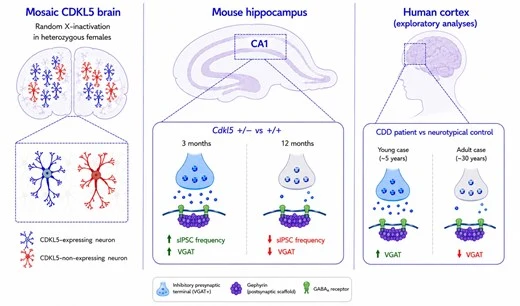
Female mice carrying one deficient copy of Cdkl5, the gene involved in CDKL5 deficiency disorder, underwent experiments comparing brain function at different ages. They had a mosaic pattern: some cells had functioning CDKL5 and others did not.
Inhibitory signals, which limit nerve-cell activity, initially strengthened in the hippocampus, a brain region involved in memory, then weakened with age. In the cortex, the brain’s outer layer, inhibitory signaling remained preserved at 3 months and increased in middle-aged mice. Complete Cdkl5 deficiency did not reproduce the progressive loss of signal-sending endings from inhibitory brain cells seen in mosaic females. The authors concluded that mosaic deficiency represented a distinct state, rather than simply a milder version of complete gene deficiency.
Why it matters
CDKL5 deficiency disorder predominantly affects females whose cells differ in CDKL5 function. The authors offered a framework for understanding how this cellular mixture may contribute to disease progression.
Caveats
The main findings came from female mice, leaving open whether people undergo the same regional changes with age. Exploratory analyses of human brain tissue after death compared young and adult cases rather than tracking changes within individuals.

Comments
Be the first to comment.