Statins and ezetimibe linked to similar cognitive risks
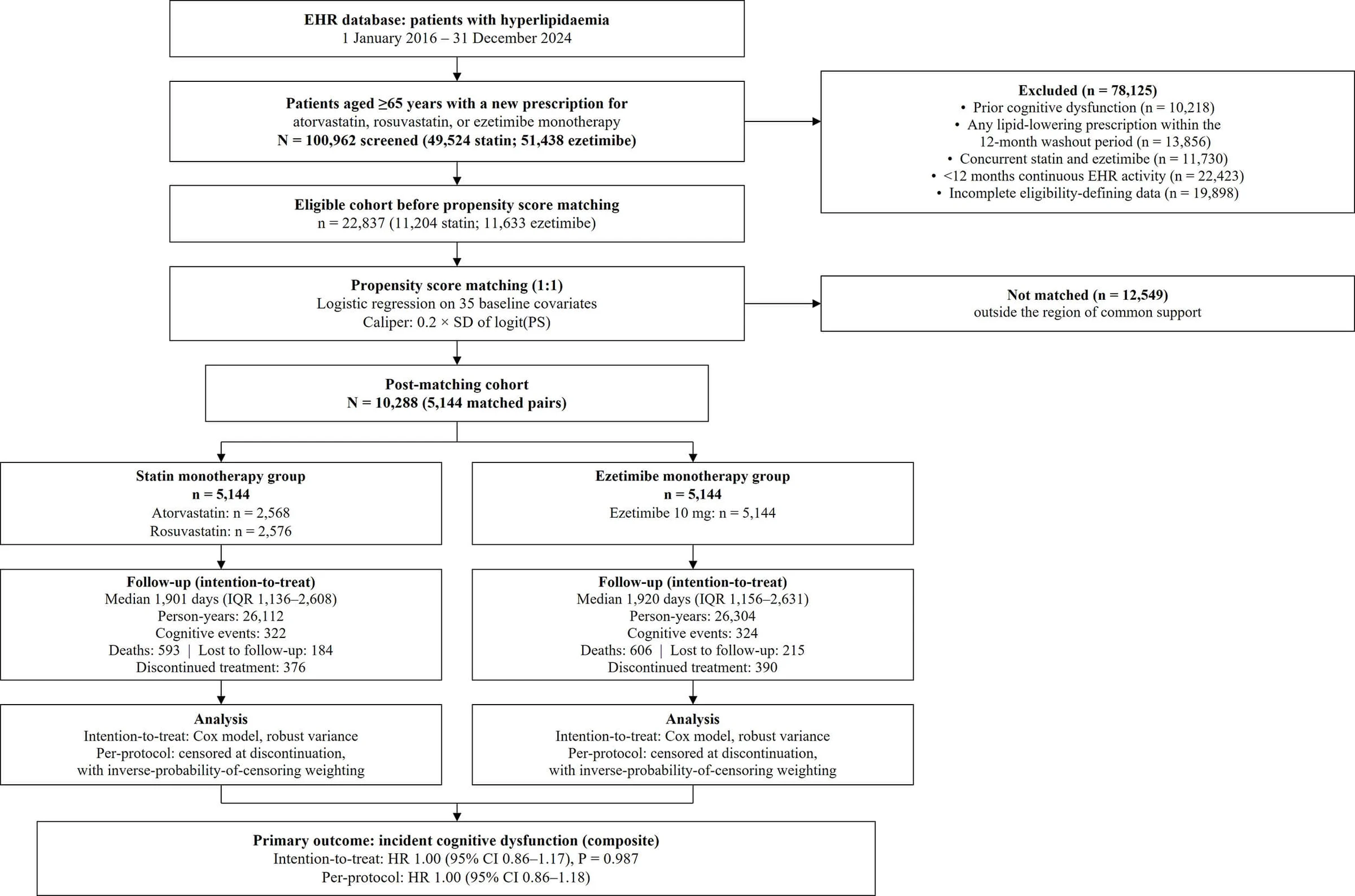
New cognitive diagnoses occurred at 12.3 per 1,000 person-years in each group, comparing statin recipients with ezetimibe recipients.
Our read
Interventions- Studied:
- Cohort study of 10,288 older Chinese adults with hyperlipidemia
- What changed:
- New cognitive diagnoses occurred at 12.3 per 1000 person-years with both statins and ezetimibe
- The catch:
- Diagnosis-code outcomes can miss cognitive problems that never receive a recorded diagnosis
- In the record:
- The 766th paper on statins with results in people; 2,090 on record in all.
Editor of record: Boris Djordjevic · AgingResearch.News
Chinese adults aged 65 or older with hyperlipidemia—high blood fat levels—were studied in a retrospective cohort using records from a Shanghai hospital from 2016 to 2024. Researchers used target trial emulation, which uses existing data to mimic a trial, and matched 10,288 patients on 35 characteristics. They compared people starting atorvastatin or rosuvastatin alone with those starting ezetimibe alone.
Cognitive dysfunction, or problems with thinking and memory, required diagnosis codes on at least two separate dates. The groups had comparable rates over 52,416 person-years of follow-up—the combined time participants were followed. Statin use was also linked to new-onset diabetes. The hazard ratio, which compares how quickly events arise during follow-up, was 1.94 versus ezetimibe.
Why it matters
For Chinese adults aged 65 or older with hyperlipidemia, the findings give no reason for cognitive concerns to guide the choice between a statin alone and ezetimibe alone, the authors concluded.
Caveats
Matching could not rule out differences between the drug groups that health records did not capture. The cohort included only adults aged 65 or older at one Shanghai hospital, and the findings did not establish equivalent cognitive risks.
Where the evidence stands
Statins
- 548 independent labs in 68 countries
- 272 findings against
- 1,470 trials, 748 with no results posted
- Funders: National Institutes of Health and others
- 219 of 2,121 findings with company ties
- 361 of 1,470 trials sponsored by its developers
Atorvastatin
- 151 independent labs in 40 countries
- 21 findings against
- 531 trials, 250 with no results posted
- Funders: National Natural Science Foundation of China and others
- 25 of 433 findings with company ties
- 72 of 531 trials sponsored by its developers
The paper
Renhe Hospital; Louisiana State University System
British Journal of Hospital Medicine, Nov 10, 2026


Comments
Be the first to comment.