Prostate screening trade-offs worsen with age in models
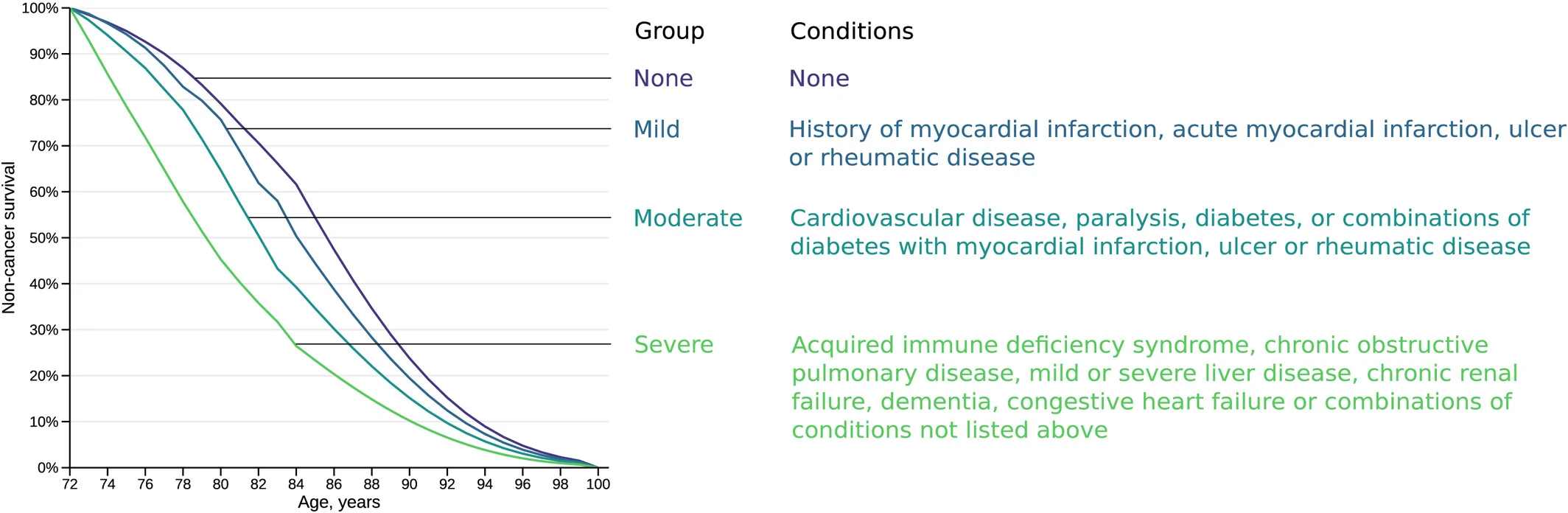
Models estimated 2.7–3.1 overdiagnoses per prostate cancer death prevented at 72 versus 4.5–5.1 at 76 in men without other illnesses.
Our read
Interventions- Studied:
- Computational study of simulated men without diagnosed prostate cancer, lifetime
- What changed:
- In men without comorbidities, overdiagnoses per cancer death prevented rose from 2.7–3.1 at age 72 years to 4.5–5.1 at age 76 years
- The catch:
- MRI and targeted biopsy accuracy were assumed constant across ages and comorbidity groups
Editor of record: Boris Djordjevic · AgingResearch.News
Men screened every two years from ages 50 to 70, with no prostate cancer diagnosis by 72, were represented in two microsimulation models, which simulated individual health histories. The models compared continued screening at ages 72, 74 and 76 across groups with different levels of other illnesses.
The approaches used a prostate-specific antigen blood level of 6.5 nanograms per milliliter to trigger magnetic resonance imaging and targeted tissue sampling. Overdiagnosis meant finding a cancer that would not have been diagnosed during a man’s lifetime without screening. Estimated overdiagnoses per prostate cancer death prevented increased with age. This ratio was at least double in men with severe life-limiting illnesses compared with men of the same age without other illnesses.
Why it matters
For older men, the estimates could help guide decisions about when to stop prostate cancer screening.
Caveats
The estimates depended on assumptions about cancer progression and screening benefits. They represented men consistently screened from ages 50 to 70, so they may not apply to men with different screening histories.
Where the evidence stands
Magnetic resonance imaging
- 9 independent labs in 7 countries
- 2 findings against
- Funders: Guangdong Medical Research Foundation and others
- Magnetic resonance imaging
- Mri-targeted biopsy
- Prostate-specific antigen screening
- Prostate cancer
- Prostate-specific antigen
- Humans
The paper
Division of Public Health Sciences Fred Hutch Cancer Center Seattle Washington USA
Cancer, Nov 12, 2026, Open access, CC BY-NC
Comments
Be the first to comment.