Age‑Related Remodeling of the Skin Microbiome in Healthy Women: Site‑Specific Patterns Between Sebaceous and Dry Skin Regions
Abstract
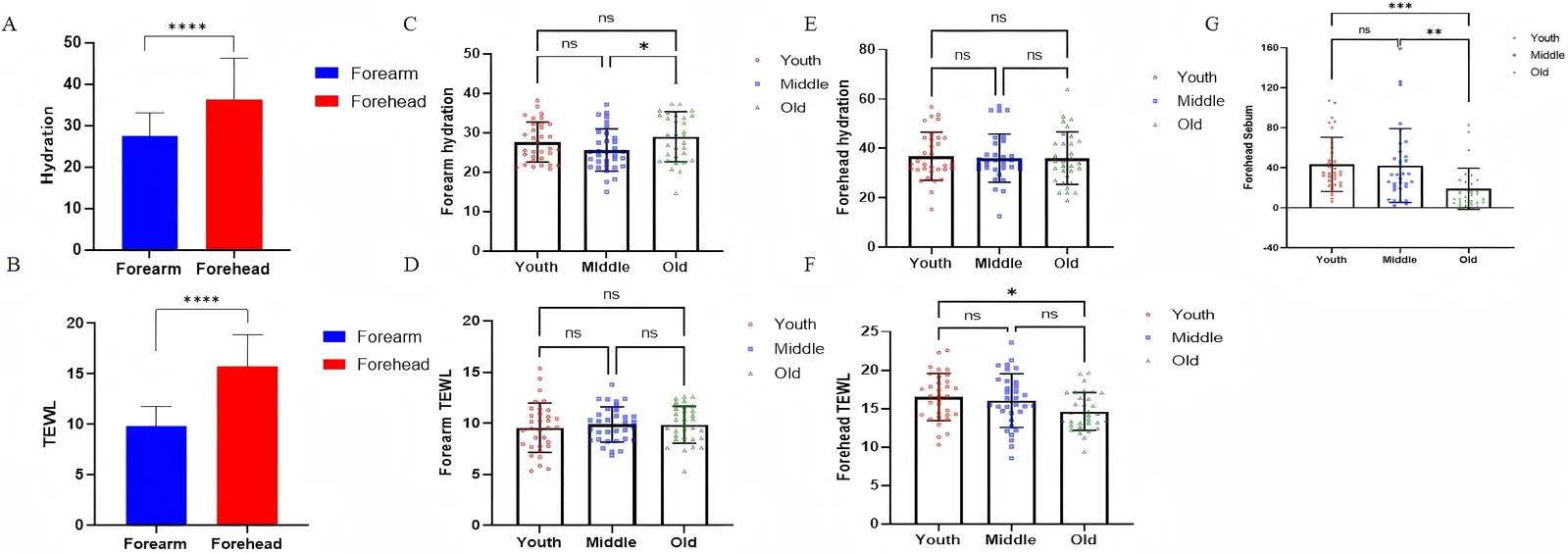
BACKGROUND: Skin microbial communities are closely related to skin physiological status and may change with both body site and age. However, age‑related variations in the healthy skin microbiome, particularly across skin sites with distinct physiological properties, remain inadequately characterized due to limited coverage of different skin sites and insufficient analyses combining age with site‑specific physiological characteristics. OBJECTIVE: To characterize age-related and site-specific differences in the bacterial communities of healthy skin and to explore their associations with skin physiological parameters. METHODS: The bacterial communities of the forehead (sebaceous site) and forearm (dry site) were analyzed in 98 healthy women aged 18-70 years using 16S rRNA gene sequencing. Skin hydration, transepidermal water loss, and sebum levels were measured, and differences among age groups and skin sites were compared. RESULTS: Age-related variation was observed in the microbiota of both skin sites. Alpha diversity increased with age in both the forehead and forearm, and this increase was most pronounced in the elderly group. On the forehead, aging was characterized mainly by a decrease in Cutibacterium (-54.83%) and increases in Corynebacterium (460.00%), Micrococcus (367.08%), Paracoccus (450.63%), and Kocuria (239.24%). On the forearm, aging was characterized by decreases in Staphylococcus (-36.01%), Streptococcus (-42.92%), Cutibacterium (-82.33%), and Lactobacillus (-41.27%), together with increases in Paracoccus (605.02%) and Chryseobacterium (900.00%). Across skin sites, the forearm showed higher bacterial diversity, whereas the forehead was dominated by Cutibacterium, whose abundance was positively correlated with sebum levels (R = 0.51193, P=0.00001) and decreased with age. Network analysis showed denser inter-genus associations in the forehead microbiota than in the forearm microbiota. CONCLUSION: Both age and skin site were associated with variation in the bacterial diversity and composition of healthy skin. Within the same skin site, age-related microbial variation was more closely aligned with changes in sebum than with hydration-related parameters. These findings provide a basis for understanding microbiome changes during skin aging and may be relevant to site-specific skin care strategies. As a cross‑sectional study with a sample of healthy women from Beijing, our findings require further validation in broader populations before generalizing.
From the paper
- Participants
A total of 98 healthy participants were selected.
Quoted word for word from the full text on dovepress.com.
- Microbiome composition
- Bacterial alpha diversity
- Bacterial diversity
- Chryseobacterium abundance
- Corynebacterium abundance
- Humans
The paper
Beijing Technology and Business University
Clinical, Cosmetic and Investigational Dermatology, Oct 12, 2026, Open access